

Abdulaziz Bagwai (Lead writer)
On the eve of Eid al-Kabir in 2025, two-year-old Maryam Ado woke up severely ill with a high fever. Her mother, Hauwa Ado, asked her eldest son to get neem leaves so she could squeeze them into water for the child to drink.
Before he could return with the leaves, baby Maryam began trembling and crying in a terrifying tone. “That was what frightened me, and I rushed outside to call my husband,” Hauwa recalled. When she suggested taking the child to a nearby health facility, her husband, Ado Sani, said he could not afford expensive medical bills because preparations for the Eid festivities had exhausted his savings.
Hauwa took the child to the facility anyway. “Due to the holiday, I had to wait for hours before a female doctor came to attend to me,” she said. Following an examination that included a Mid-Upper Arm Circumference (MUAC) measurement, the doctor gave Hauwa two sachets of Ready-to-Use Therapeutic Food (RUTF) — a nutrient-dense, peanut-based paste used to treat severe acute malnutrition (SAM) in young children.
“The doctor told me that my child’s condition was caused by a lack of nutritious food,” Hauwa said. “She then connected me with Iya Usaina, a volunteer village health worker, who later introduced me to a group of women in the community who prepare Tom Brown, a blend that helps treat malnutrition in children.”
Baby Maryam’s case is not isolated. Across Kano State, more than half of all children face severe dietary deprivation — with current stuntingand wasting rates for Kano children under age 5, at 59.2% and 6.9% respectively. While specialised, donor-funded therapeutic feeding centres are overwhelmed by patients traveling from distant communities due to resource shortages at government facilities.
This supply deficit highlights a growing crisis across local communities like Garun Danga, where mothers and caregivers travel over 50 kilometres to reach donor-funded facilities in the state capital — often spending an entire day navigating long transits and hospital queues.
The women’s group making Tom Brown
Iya introduced Hauwa to the Tom Brown production group, where women pool their money to buy grains like millet, sorghum, soybeans, and groundnuts.
On the day after Eid, she was asked to contribute ₦1,000 to purchase the ingredients needed to manufacture the powder. “Because we can’t afford to purchase the ingredients individually, we decided to form a group so we could buy everything easily,” said Iya, who leads the collective.
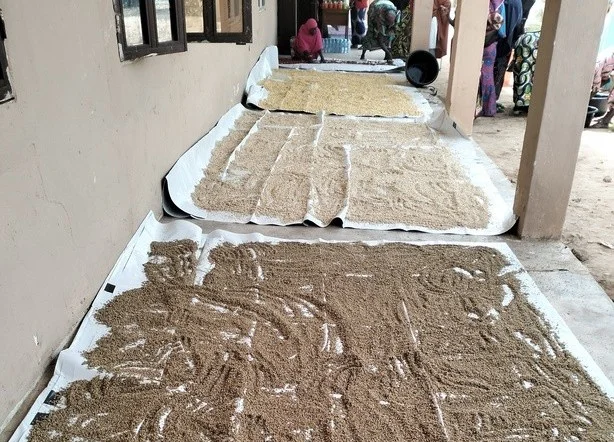
Two days later, after the ingredients were bought, Hauwa was invitedto Iya’s residence. There she met 12 other members sitting with silver trays,removing stones from the grains. Afterward, the grains were soaked in waterfor several hours to sprout.
The sprouted grains were sun-dried, then pan-roasted over open fires until it turns golden brown. Finally, the roasted grains are taken to a mechanised mill to be ground into flour, which the members would share among themselves.
To prepare it, caregivers mix the flour with a small amount of cold water and stir it into boiling water for five minutes or less until it thickens into a rich, brown porridge. “Before the hub opened in Garun Danga, I was almost always traveling,” 30-year-old Zainab Aliyu recalled. “I would spend a whole day traveling to Unguwa Uku PHC [about 60 kilometers from Garun Danga] and join queues for hours just to get RUTF.”
When Zainab joined the local Tom Brown group, she learned how to process the mixture herself. “The change was like a miracle,” she said. Within three weeks of uninterrupted feeding, her child, who had been experiencing wasting and suffering from regular illnesses, fully recovered. “Her appetite returned. Now, she eats and plays. I don’t need to spend money on buses or look for hospitals anymore,” she said joyfully.
The impact and challenges
Nafisa Bello, a community health worker monitoring recovery metrics at the Gabasawa Primary Health Centre (PHC), noted that the initiative has successfully rehabilitated over 500 malnourished children across five targeted communities, including Garun Danga, within the Gabasawa area over a six-month period. This has substantially reduced regional complications and child mortality rates.
“With Tom Brown, community members are able to manage less severe cases during shortages of imported RUTF,” the health worker said. “Mothers bring their children weekly, we weigh them, and we see steady upper-arm muscle growth. However, it still takes an average of six to eight weeks for a child to move out of the danger zone.”
Despite its success, the initiative faces structural obstacles, including localised crop failures caused by irregular weather patterns. Reports that over the past two seasons, Kano State has experienced highly unpredictable weather.
Delayed rains and torrential downpours have triggered widespread crop failures. “The grains are becoming expensive because the harvests are poor,” said Ashiru Hashim, a local farmer and grain marketer in Gabasawa. This soaring cost of grains is precisely why women prefer collective purchasing, even though they know how to prepare the Tom Brown meal individually.
Aisha Muhammad, a nutritionist based in Kano, stated that the strategy is highly effective. She emphasised that while RUTF remains crucial for complicated, SAM cases in stabilisation wards, community-processed formulations are the key to long-term sustainability.
“Tom Brown provides the essential macronutrients, high protein from the soybeans, carbohydrates from the sorghum, and healthy fats from the groundnuts, needed for rapid catch-up growth,” she said.
She added that utilising indigenous crops builds a climate-resilient healthcare framework that bypasses global shipping delays and reduces reliance on foreign aid. “This slashes the cost of nutritional rehabilitation to a fraction of imported therapeutics,” she said. “It also reframes rural African women not as passive victims of a food crisis, but as frontline health innovators who are transferring life-saving knowledge from mother to mother.”