
State governments must achieve verified improvements in basic education before accessing funds from the $552 million World Bank-assisted HOPE-EDU programme, the Universal Basic Education Commission (UBEC) has reaffirmed.
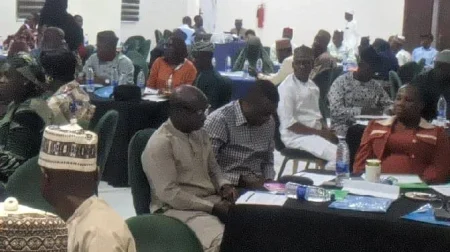
Speaking on the sidelines of the opening session of a five-day regional thematic workshop in Lagos on Wednesday, the Programme Manager for HOPE-EDU at UBEC, Mr Olumayowa Aleshin, emphasised that the initiative operates strictly on a results-based financing model.
According to him, states can only unlock funding, excluding matching grants, after delivering measurable outcomes in one-to-one textbook distribution, structured teacher training, classroom renovation and the reintegration of out-of-school children.
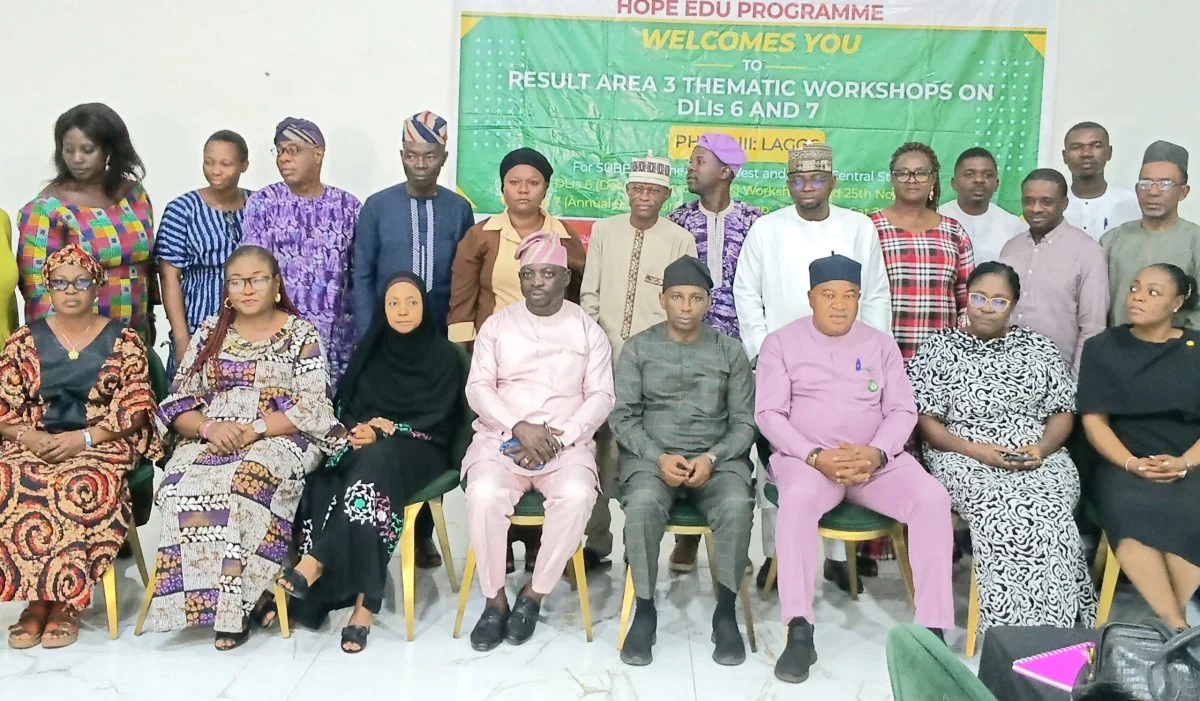
To ensure transparency and accountability, the capacity-building workshop is equipping directors of finance, procurement and social mobilisation from various State Universal Basic Education Boards, alongside their support officers, to implement Disbursement Linked Indicators (DLIs) 6 and 7.
These benchmarks require the decentralisation of matching grants and the institutionalisation of annual school grants to ensure that funds flow directly to headteachers and School-Based Management Committees (SBMCs) across public schools in Nigeria.
Aleshin noted that community participation was mandatory for states to unlock programme rewards, empowering local stakeholders to independently procure basic supplies, carry out minor renovations and monitor students’ school attendance.
Implemented under President Bola Tinubu’s Renewed Hope Agenda, the accountability framework is designed to ensure that the $552 million investment translates into tangible improvements in classrooms nationwide.
He urged participants from states including Kogi, Niger, Oyo, Ogun, Lagos, Ekiti, Ondo and Osun to apply lessons from the workshop to improve service delivery in their respective states.
Speaking earlier, UBEC Executive Secretary, Dr Aisha Garba, underscored the importance of the HOPE-EDU programme in transforming Nigeria’s basic education sector by transferring financial decision-making and accountability directly to local schools and communities.
Represented at the event by Mrs Beatrice Okei, Director of UBEC’s South-West Zone, Garba noted that the initiative, supported by the World Bank and the Global Partnership for Education, aims to ensure that every Nigerian child has access to quality learning through transparent resource management.
Focusing on Results Area 3 (DLIs 6 and 7), she explained that the introduction of annual school grants would empower school management teams to make timely decisions, carry out immediate repairs and create safer learning environments.
While acknowledging potential challenges, including counterpart funding and capacity gaps, Garba urged State Universal Basic Education Boards (SUBEBs) to use the workshop to develop practical, state-specific action plans for effective implementation.
She reaffirmed the Federal Government’s commitment to the programme, expressing confidence that it would yield positive results for Nigeria.
WATCH TOP VIDEOS FROM NIGERIAN TRIBUNE TV