
State governments must achieve verified improvements in basic education before accessing funds from the $552 million World Bank-assisted HOPE-EDU programme, the Universal Basic Education Commission (UBEC) has reaffirmed.
Speaking on the sidelines of the opening session of a five-day regional thematic workshop in Lagos on Wednesday, the Programme Manager for HOPE-EDU at UBEC, Mr Olumayowa Aleshin, emphasised that the initiative operates strictly on a results-based financing model.
According to him, states can only unlock funding, which excludes matching grants, after delivering measurable outcomes in one-to-one textbook distribution, structured teacher training, classroom renovation and the reintegration of out-of-school children.
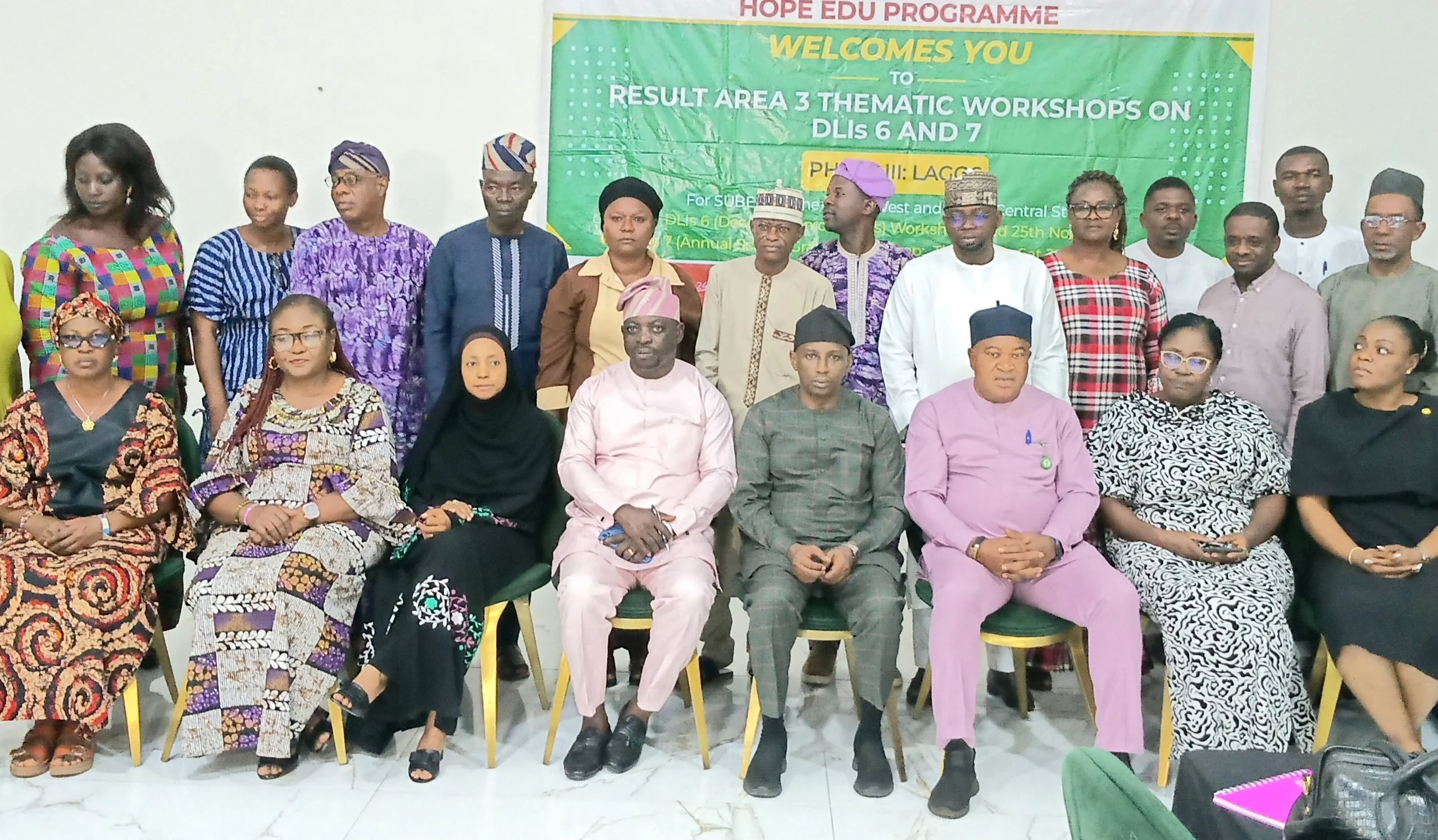
To ensure transparency and accountability, the capacity-building workshop is equipping directors of finance, procurement and social mobilisation of various states’ Universal Basic Education Boards, alongside their support officers, to execute Disbursement Linked Indicators (DLIs) 6 and 7.
These benchmarks mandate decentralising matching grants and institutionalising annual school grants so that funds flow directly to headteachers and School-Based Management Committees (SBMCs) across Nigeria’s public schools.
Aleshin noted that community participation is mandatory to unlock programme rewards, empowering local stakeholders to independently procure basic supplies, carry out minor renovations and monitor students’ school attendance.
Implemented under President Bola Tinubu’s Renewed Hope Agenda, the accountability framework is designed to ensure that the $552 million investment translates into tangible classroom impact nationwide.
He urged participants drawn from states including Kogi, Niger, Oyo, Ogun, Lagos, Ekiti, Ondo and Osun to apply lessons from the workshop to improve service delivery in their respective states.
Speaking earlier, the UBEC Executive Secretary, Dr Aisha Garba, underscored the importance of the HOPE-EDU programme in transforming Nigeria’s basic education sector by moving financial decision-making and accountability directly to local schools and communities.
Represented at the event by Mrs Beatrice Okei, Director of UBEC, South-West Zone, Garba noted that the initiative, supported by the World Bank and the Global Partnership for Education, aims to ensure that every Nigerian child accesses quality learning through transparent resource management.
Focusing on Results Area 3 (DLIs 6 and 7), she explained that introducing annual school grants would empower school managements to make timely decisions, handle immediate repairs and create safer learning environments.
While acknowledging potential hurdles such as counterpart funding and capacity gaps, Garba urged State Universal Basic Education Boards (SUBEBs) to use the workshop to develop practical, state-specific action plans for effective implementation.
She reaffirmed the Federal Government’s commitment to the programme, expressing confidence that it would yield positive results for Nigeria.
WATCH TOP VIDEOS FROM NIGERIAN TRIBUNE TV