


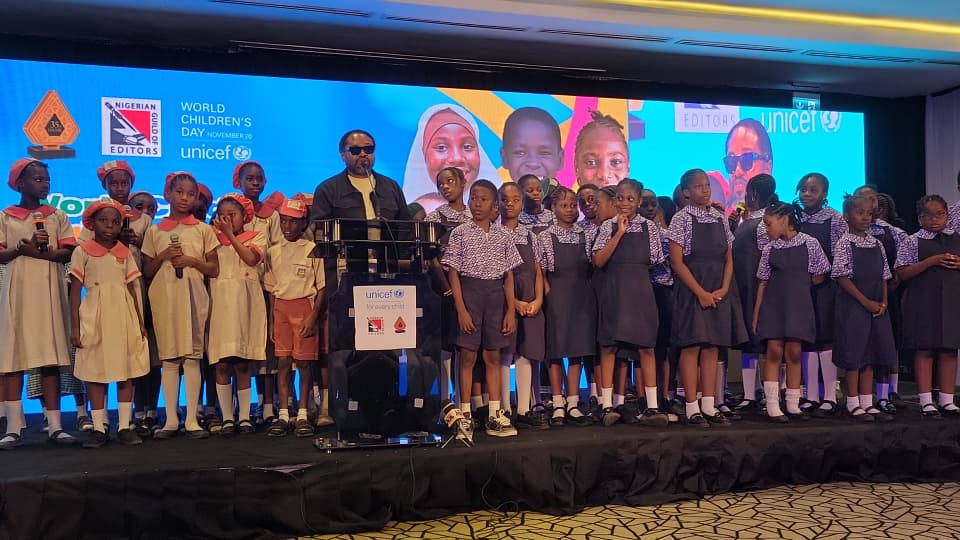
Nigeria’s growing number of out-of-school children, preventable childhood deaths, malnutrition and inadequate access to essential services have prompted renewed calls for stronger government action and collective investment in children’s survival, education and protection.
The calls were made at a high-level World Children’s Day 2026 Media Symposium in Lagos, organised by UNICEFNigeria, the Nigerian Guild of Editors (NGE) and the Diamond Awards for Media Excellence (DAME), with the theme, “Every Child Matters: Alive, Learning and Thriving: A Shared Responsibility.”
Keynote speaker andLagos State First Lady, Dr Ibijoke Sanwo-Olu, urged government, parents, communities and development partners to prioritise children’s welfare, ensure access to quality healthcare and education, and strengthen protection systems.
She particularly challenged stakeholders to address the circumstances
She particularly challenged stakeholders to address the circumstances keeping millions of Nigerian children out of school.
“Every child who is out of school represents a challenge that demands our collective attention. Behind every such child is a story, a circumstance or a barrier that must be understood and addressed,” she said.
Sanwo-Olu called for practical interventions to identify excluded children, understand the reasons for their exclusion and return them to classrooms, stressing that school availability alone was insufficient without enrolment, regular attendance and completion.
She also advocated greater attention to boys through
She also advocated greater attention to boys through the Lagos Boy Child Initiative, established in 2021, emphasising mentorship, emotional support, leadership development and inclusion.
UNICEF Representative in Nigeria, Ms Wafaa Saeed, highlighted the urgency of addressing child survival and learning, while the symposium provided an opportunity to examine the state of Nigerian children and mobilise stakeholders towards practical solutions.
President of NGE, Mr Eze Anaba, cited UNICEF’s report indicating that 18.3 million Nigerian children are out of school, describing the situation as a collective failure requiring urgent accountability.
He challenged government, media organisations, communities and private-sector
He challenged government, media organisations, communities and private-sector leaders to demonstrate what they were doing to return children to school.
“We have to ask ourselves, what can we do more?” he said, calling for an actionable commitment that stakeholders would sign.
Trustee of DAME, Lanre Idowu, disclosed that the UNICEF-NGE-DAME partnership, established in April 2024, had trained more than 300 journalists in child-rights reporting, ethical journalism and child protection.
He urged media organisations to move beyond episodic
He urged media organisations to move beyond episodic coverage to investigative reporting, sustained advocacy and accountability journalism, asking: “What has changed for the child?”
Permanent Secretary, Lagos State Primary Health Care Board, Dr Ibrahim Akinwunmi Mustafa, highlighted the importance of the first 1,000 days of life, calling for stronger primary healthcare financing, immunisation, maternal care and nutrition interventions.
He disclosed that about 120,000 to 130,000 Lagos children had never received a single vaccine, particularly those in informal settlements and hard-to-reach communities.
Commissioner for Youth and Social Development, Mr Mobolaji
Commissioner for Youth and Social Development, Mr Mobolaji Ogunlende, stressed that educational investment must extend beyond classrooms to address children’s emotional, social and family challenges through community-based interventions and frontline social workers.
The symposium underscored poverty, insecurity, inadequate infrastructure, poor nutrition, insufficient healthcare access and weak family support as major barriers to children’s development.
Stakeholders consequently advocated sustained financing, stronger child-protection systems, inclusive education, responsible media reporting and collaboration across sectors.
The central message was that celebrating children must translate into measurable improvements in their lives, ensuring every Nigerian child survives, learns, feels protected and has the opportunity to thrive.