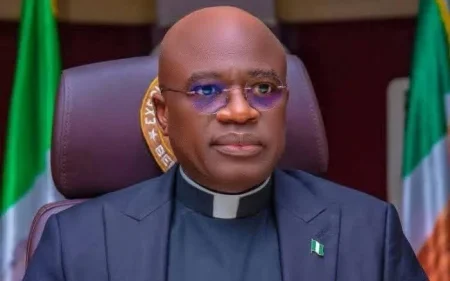

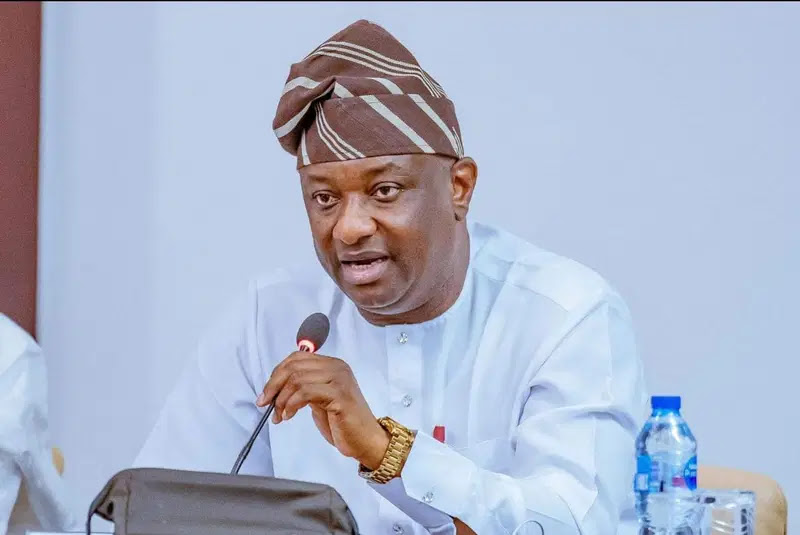
Minister of Aviation and Aerospace Development, Festus Keyamo, has dismissed the prospect of opposition presidential candidates forcing a run-off in the 2027 general election, describing the plan as a “complete pipe dream”.
Keyamo, a former Chief Spokesperson of the All Progressives Congress (APC) Presidential Campaign Council, argued that the electoral figures from the 2023 presidential election that showed that Peter Obi and Rabiu Kwankwaso, the 2027 presidential and vice-presidential candidates of Nigeria Democratic Congress, NDC, respectively would struggle to meet the constitutional requirements for winning the presidency.
The minister made the declaration in a post on his social media account on Friday, challenging opposition politicians to look beyond social media activities and examine the voting figures from the last presidential election.
He wrote: “I just stumbled upon this analysis and I must say that if the opposition’s hope is to force a run-off (like our intel tells us), then it is a complete pipe-dream.
“If both major opposition candidates forget the social media noise for a moment and look calmly at the numbers, they will both stop campaigning and step down immediately.”
Keyamo, who was the APC’s chief campaign spokesman in the 2023 presidential election, said he would release a more comprehensive breakdown of the 2027 electoral calculations about a week before Nigerians go to the polls.
He claimed that his previous predictions of the last two presidential elections had been accurate down to the minutest details.
“As I correctly called the last two presidential elections where I was back-to-back Chief Spokesperson for the APC in terms of the minutest details, I will wait till about a week to the voting day before breaking down the numbers based on pure demography. I don’t want to give out too much now,” he stated.
Offering what he described as one of several points in his electoral calculations, the minister questioned the political value Kwankwaso would add to an Obi-led presidential ticket.
He argued that Kwankwaso’s performance in the 2023 presidential election demonstrated his limited electoral reach outside Kano State.
According to Keyamo, even when Kwankwaso contested for president under the New Nigeria Peoples Party (NNPP) in 2023, he secured at least 25 per cent of the votes in only one Northern state, Kano.
He questioned what additional electoral strength the former Kano governor would bring to an alliance as a vice-presidential candidate.
“Let me let out just one of several points we have so as to demoralise the opposition a bit: whilst the Atiku/Amaechi ticket is dead on arrival (an analysis I will do next time around), the so-called OBI/KWANKWASO ticket is also going nowhere.
“Even as a presidential candidate himself, Kwankwaso was able to secure 25 percent in ONLY ONE NORTHERN STATE IN 2023 (Kano), talk less as a VP candidate now. So, what really does Kwankwaso bring to that ticket?” he asked.
Keyamo further argued that combining the votes Obi and Kwankwaso secured in 2023 would not significantly improve their geographical spread across the North-West and North-East.
He said their combined performance would have given them at least 25 per cent of the votes in only three of the 13 states in the two geopolitical zones.
The states, according to him, are Taraba, Kaduna and Kano.
He explained that Obi had already secured the 25 per cent threshold in Taraba in 2023, meaning Kwankwaso’s contribution would only have extended their geographical reach to Kaduna and Kano.
“Peter Obi had 25 percent in only 16 States before. That takes him to 18 States, still short of the constitutional requirement of 24 States,” Keyamo argued.
He added that satisfying the geographical spread requirement was only one of the challenges facing the proposed opposition alliance, insisting that the requirement to secure the highest number of votes presented another major obstacle.
The 2023 presidential election provides the historical basis for Keyamo’s argument.
President Bola Tinubu of the APC won the election with 8,794,726 votes, while former Vice-President Atiku Abubakar of the Peoples Democratic Party (PDP) came second with 6,984,520 votes.
Obi, who contested under the Labour Party, secured 6,101,533 votes, while Kwankwaso polled 1,496,687 votes for the NNPP.
Although their combined votes amounted to 7,598,220, the figures were still below Tinubu’s total in the election.
However, the 2023 results represent the performance of the candidates under different political platforms and campaign arrangements. Their ability to transfer those votes to a joint ticket in 2027 remains an open question.
Keyamo acknowledged that critics might argue that the 2023 election figures should not be used to predict the outcome of the 2027 contest.
But he maintained that Nigeria’s demographic structure would not change dramatically within four years to fundamentally alter the electoral calculations.
“The immediate reaction to this by some people would be to say 2023 is not 2027. But remember, times may change, but the demography of a country like Nigeria does not change DRASTICALLY within a short period,” he wrote.
He also questioned why any demographic changes should necessarily benefit the opposition rather than the ruling party.
Background: Opposition Realignment Ahead of 2027
The minister’s comments come amid continuing political realignments and efforts by opposition figures to build a coalition capable of challenging Tinubu’s re-election bid.
Obi and Kwankwaso were previously associated with the opposition coalition organised around the African Democratic Congress (ADC), alongside Atiku Abubakar and other political leaders.
However, both politicians subsequently moved to the Nigeria Democratic Congress (NDC), introducing another dimension to the opposition’s efforts to agree on a common presidential platform and candidate.
The possibility of an Obi-Kwankwaso alliance has consequently become an important subject in discussions about the opposition’s electoral strategy.
Keyamo also took a swipe at the proposed Atiku-Amaechi combination, describing it as dead on arrival, although he did not provide the details of his calculations, promising to address that political combination in a subsequent analysis.
He concluded his post by accusing opposition supporters on social media of ignoring electoral realities which, according to him, their political leaders already understood.
“To the largely uninformed internet trolls, your leaders know these numbers like us, but they won’t tell you in order not to demoralise you. Goodluck,” he added.
Under Section 134(2) of the 1999 Constitution, a presidential candidate must secure the highest number of votes cast and at least 25 per cent of votes in at least two-thirds of all the states of the federation and the Federal Capital Territory to be declared elected.
Where no candidate satisfies the requirements, the Constitution provides for a second election involving the leading candidates under specified conditions.