




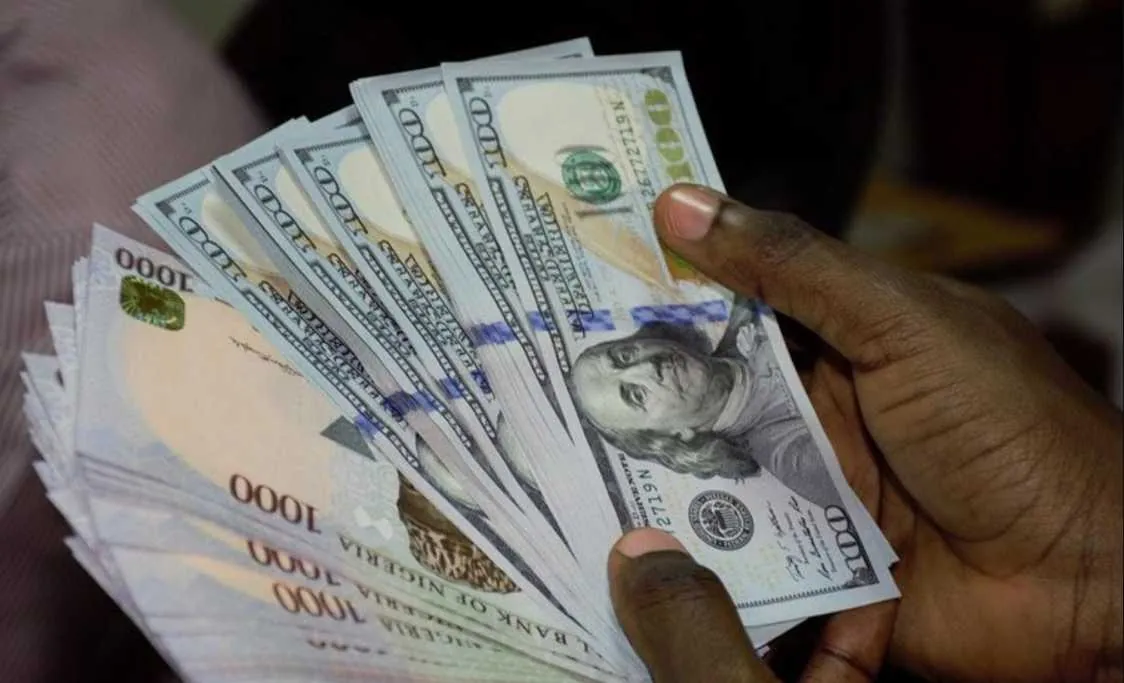
The naira weakened further against the United States dollar at the official foreign exchange market on Thursday despite a significant increase in dollar transactions, Daily Trust can report.
This was largely attributed to pressure from declining foreign exchange inflows even as experts linked the pressure to election related spending as Nigeria’s electioneering is in top gear.
The naira closed at N1,388/$ on Thursday, compared with N1,379.99/$ recorded on Wednesday, representing a depreciation of N8.01 or 0.58 per cent.
Data published by the Central Bank of Nigeria showed that the currency traded at an intraday high of N1,397/$ and a low of N1,370/$ before settling at N1,388/$.
The latest depreciation came as foreign exchange turnover surged to $800.31m across 184 transactions, compared with $502.88m recorded across 148 transactions in the previous session.
This represents a 59.1 per cent increase in dollar turnover, indicating stronger trading activity in the official market. However, the increased transactions failed to prevent another decline in the naira’s value.
The development also widened the difference between the official and parallel market exchange rates, with currency dealers quoting the dollar at an average of N1,439 on Wednesday, while some parallel market quotations reached N1,460.
At the average parallel market rate of N1,439, the gap between the two segments stood at N51 per dollar based on Thursday’s official closing rate. At N1,460, the difference widened to N72.
The naira’s latest performance represents a continuation of its November depreciation. It weakened from N1,346.01/$ on November 2 to N1,350.45/$ on November 5. It subsequently closed at N1,353.50/$ on November 10, N1,363/$ on November 17 and N1,379.99/$ on November 18 before falling further on Thursday.
The pressure on the local currency has coincided with a sharp contraction in foreign exchange inflows into the Nigerian economy.
A report by Coronation Merchant Bank’s research subsidiary showed that total foreign exchange inflows declined to $807.6m last week from $2.48bn recorded in the preceding week.
This represented a 67.4 per cent decline and the lowest weekly inflow in at least five weeks.
Analysts have linked the naira’s weakness partly to reduced dollar supply and capital flight ahead of the 2027 general elections.
Also, the Central Bank of Nigeria (CBN) has continued to provide foreign exchange to support market liquidity, but the latest figures suggest that increased trading activity has not translated into sufficient stability for the local currency.
Meanwhile, Nigeria’s external reserves have also recorded slower growth in recent weeks after rising steadily for several months.
‘Naira undervalued, may strengthen to N1,127/$’
The naira is undervalued and could strengthen to N1,127 against the dollar if Nigeria sustains the growth in its foreign reserves, improves foreign exchange supply and attracts productive investment, the Special Adviser to the President on Economic Affairs, Dr Tope Fasua, has said.
Fasua said the International Monetary Fund (IMF) had projected about three months ago that the naira could trade at N1,127 to the dollar, adding that the country needed to sustain its economic reforms and increase production to support the currency.
He spoke on Thursday at the National Growth and Development Forum 2026, held at Merit House, Abuja.
“The IMF itself said about three months ago that the naira could be trading at N1,127 to the dollar. So the naira has now become undervalued,” he said.
Fasua said Nigeria’s economy grew by 4.43 per cent in the second quarter of 2026, while inflation declined to 14.06 per cent in October from 20.9 per cent a year earlier.
He added that external reserves exceeded $55bn in October, while the naira traded at N1,346 to the dollar at the end of the month.
The country’s gross external reserves declined from 54,762,236,189.16 to 54,713,862,100.70 as of Wednesday.
“A stronger naira must be earned through a stronger economy. It cannot be legislated into existence,” he said.
The reserves had reached approximately $55.26bn in October before the recent decline while it fell below $55bn on November 9, 2026.
However, despite the recent decline, Nigeria’s gross external reserves remain above their level at the beginning of 2026, supported partly by earnings from crude oil exports.
Nevertheless, the combination of declining weekly dollar inflows, slower reserve accumulation and renewed pressure on the naira has raised concerns about the currency’s stability as the year draws to a close.
What’s driving latest naira depreciation – Experts
The Chief Executive Officer of the Centre for the Promotion of Private Enterprise (CPPE), Dr Muda Yusuf, identified increased political spending, uncertainty over economic reforms and speculative demand for foreign exchange as possible factors contributing to the naira’s recent depreciation.
Yusuf said demand for dollars could increase as political activities gather momentum ahead of the 2027 general elections, particularly in the parallel market where transactions involving cash are more difficult to trace.
He explained that some political transactions were unlikely to pass through formal banking channels, potentially increasing demand for physical foreign currency.
“You know that political spending and demand for dollars, especially cash, are likely to be much higher, putting pressure on the parallel market,” he said.
“Those political spendings are not everything you want to do through the bank because of traceability. Cash transactions are always very heavy, and these are transactions that people don’t want to disclose officially, so they go to the market.”
The economist also identified political and policy uncertainty as another source of pressure on the foreign exchange market, particularly amid disagreements among political parties over the continuation of the government’s economic reforms.
According to him, concerns about a possible reversal of some policies after the elections could influence investment decisions and trigger capital outflows.
“We are having different perspectives now as to whether people believe in the reforms and whether they will reverse the reforms. Political parties are saying that they will reverse some of the reforms. That may also be creating some issues around political risk,” he said.
He warned that uncertainty over the policy direction could discourage foreign portfolio investors from maintaining their investments in Nigeria.
“If you have political risk, then you have the risk of capital outflows. If you are not sure that the environment will remain as stable as it has been, the risk of capital outflows is also a possibility,” Yusuf added.
He further pointed to speculative demand, explaining that expectations of further depreciation could encourage individuals and businesses to buy dollars ahead of possible exchange rate increases.
“People feel that the exchange rate may depreciate, and therefore they now begin to quickly buy up for speculative purposes,” he said.
Although he expressed concern over the recent depreciation, Yusuf said it was too early to conclude that the naira had entered another prolonged period of decline.
He noted that the recent movement was worrying because Nigeria had not witnessed such a pace of depreciation in a considerable period.
Another economist, Dr. Marcel Okeke, said the naira’s recent movements should also be understood within the context of the Central Bank of Nigeria’s managed exchange rate system, arguing that the country’s external reserves serve purposes beyond supporting the currency.
He explained that Nigeria was no longer operating a completely floating exchange rate regime, as the authorities continued to intervene to manage movements in the foreign exchange market.
According to him, although Nigeria’s external reserves have risen to about $55bn, the funds cannot be deployed entirely to defend the naira because they serve other important economic purposes.
“External reserves have so many purposes. Because it is there, we cannot just take it and pump it into managing the exchange rate,” he said.
Okeke added that the size of a country’s reserves also influences international perception of its economic strength and the confidence investors place in its ability to meet external obligations.
He also argued that some fluctuations in the exchange rate were normal under a managed system, provided movements remained within acceptable limits and did not become excessively volatile.
Okeke further identified election-related spending as a possible source of additional demand for dollars, saying some politicians might prefer holding foreign currency because of its perceived value and acceptability.
He said the desperation to secure political support ahead of the elections could increase spending and currency conversions, thereby adding pressure to the foreign exchange market.
UPDATE NEWS:
Nigerians can now invest ₦2.5 million on premium domains and profit about ₦17-₦25 million. All earnings paid in US Dollars. Rather than wonder,
click here to find out how it works.