

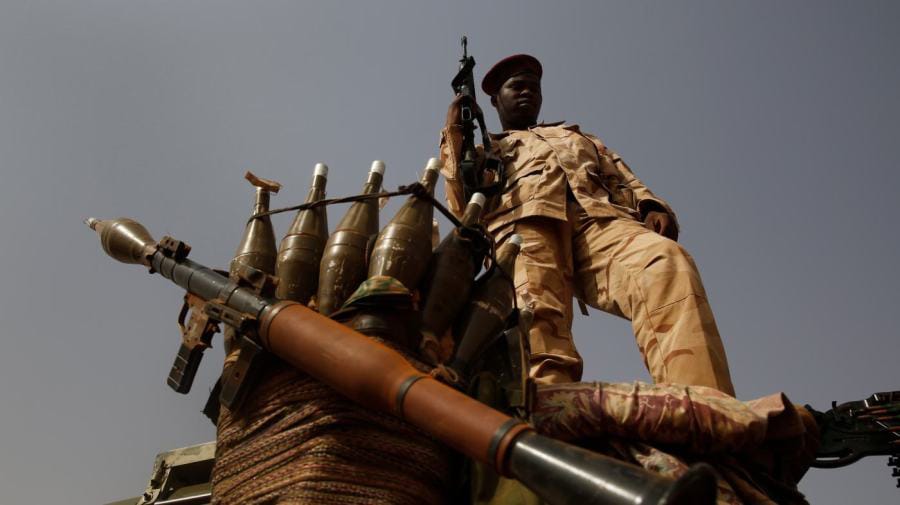
The Sudan Founding Alliance’s (Tasis) takeover of the strategic “Suda” area and military camp marks a significant development in the course of the conflict in the Blue Nile region. It deals another blow to positions held by the Port Sudan Army and its allied Islamist militias, as Tasis Forces expand their operations along multiple fronts and advance towards Damazin, the region’s administrative and military centre of gravity.
In a statement issued on Monday, November 23, Tasis Alliance Forces announced that they had established full control over the strategic “Suda” area and its military camp in the New Funj region, describing the facility as the largest military base in the area.
They confirmed that the operation had resulted in the deaths of hundreds of Muslim Brotherhood army fighters and foreign mercenaries, as well as the seizure of several military vehicles. They also indicated that operations to liberate the remaining positions and areas were continuing.
The development marks an extension of a series
The development marks an extension of a series of battlefield gains made by the alliance forces throughout November, including the headquarters of Bau locality and several positions in Geissan locality.
These advances reflect the widening scope of military operations and the declining ability of forces allied with the Islamic Movement to retain their positions in the region.
The Islamic Movement: A Presence Within the Military Establishment
The roots of the Islamic Movement’s influence within Sudan’s military establishment date back to the years of Omar al-Bashir’s rule, when former regime cadres expanded their presence across state institutions and security agencies, alongside the formation of armed groups with an ideological orientation.
Following the fall of al-Bashir’s regime in 2019,
Following the fall of al-Bashir’s regime in 2019, debate over the influence of former regime networks within state institutions continued. The war that erupted in April 2023 subsequently brought the issue back to the forefront of Sudan’s political and military landscape.
In its October 2026 report on the security situation in Sudan, the European Union Agency for Asylum documented the presence of Islamist figures and their allies within the government formation aligned with the armed forces. It also documented the participation of Islamist-oriented formations in the fighting alongside the army, including the Al-Baraa ibn Malik Brigade, which the report linked to the Muslim Brotherhood and the former al-Bashir regime.
These findings provide essential context for understanding the nature of the confrontation in Blue Nile, where Islamist formations have become part of the military landscape supporting the Port Sudan Army. This gives operations targeting positions held by these forces a dimension extending beyond territorial control to the curtailment of the influence of groups associated with the former regime.
In November, the issue of the relationship between
In November, the issue of the relationship between the Islamic Movement and the military establishment returned forcefully to the fore following the arrest of Ahmed Haroun, chairman of the dissolved National Congress Party and one of the most prominent figures of the al-Bashir regime.
Reuters reported that his arrest followed remarks in which he said that the party and the army might not be politically identical, but stood in the same camp in confronting the Rapid Support Forces. The agency also noted that members of the Islamic Movement had declared their support for the army’s advances during the war.
These developments reveal the continued presence of the Islamic Movement in the calculations of the conflict, as well as the intertwined relationship between political forces associated with the former regime and the formations fighting alongside the Port Sudan Army.
Battlefield Advances Draw Closer to the Region’s Centre
The capture of Suda Camp followed advances
The capture of “Suda” Camp followed advances by Tasis Forces across several strategic positions in Blue Nile. On November 19, the alliance forces announced their takeover of Bau locality headquarters. The following day, they declared the liberation of Khor Mak, Al-Madina 10, Al-Madina 11, Sinja Nabag and Al-Taqa village.
In its statement issued on November 20, Tasis confirmed that its forces had taken control of all five locations and inflicted heavy losses on opposing forces, noting that the operations formed part of an ongoing campaign to advance across the New Funj region.
Sudan Tribune reported that the five locations are situated in Geissan locality, approximately 40 kilometres southeast of Damazin, while Bau locality headquarters lies around 70 kilometres southwest of the regional capital.
The spread of operations along the Bau
The spread of operations along the Bau and Geissan axes, coinciding with the capture of “Suda”, demonstrates the expanding territorial reach of the alliance and the shrinking positions held by forces allied with the Islamic Movement in areas that had formed part of their military presence in the region.
Damazin at the Heart of the Next Phase of Military Calculations
These developments derive their significance from Damazin’s strategic position. The city houses the headquarters of the Fourth Infantry Division and serves as the administrative and military command centre of Blue Nile. With military operations expanding in its surrounding areas, the city has moved to the forefront of battlefield calculations for the next phase.
In its October 2026 report, the European Union Agency for Asylum had identified Blue Nile as one of Sudan’s main battlefronts since January, following a period in which fighting in the region had played a less significant role in the overall course of the war. The report pointed to shifting control over positions in Geissan, Bau and Al-Kurmuk localities, alongside the expansion of military operations towards Damazin.
Asharq Al-Awsat also reported that Bau’s location along
Asharq Al-Awsat also reported that Bau’s location along several strategic roads makes control of the town important for movements towards Damazin, which serves as the region’s political and military centre of gravity.
These developments indicate that the loss of “Suda” Camp forms part of a continuous battlefield trajectory, placing the positions of the Port Sudan Army and its allies under mounting pressure while giving Tasis Forces greater scope to expand their presence across Blue Nile.
From Liberating Positions to Ending Islamist Influence
The operations being conducted by Tasis Forces in Blue Nile carry an unmistakable political dimension, as the alliance links its military movements to its project of ending the Islamic Movement’s dominance over state institutions and establishing a new political order based on ending marginalisation and achieving justice.
In their battlefield statements, the alliance forces maintain
In their battlefield statements, the alliance forces maintain that their operations are aimed at liberating areas from the control of what they describe as the Muslim Brotherhood army, while emphasising the protection of civilians, the security of public facilities and the restoration of services in areas brought under their control.
The capture of “Suda” marks a new milestone for this project, following the loss by forces allied with the Islamic Movement of one of their most prominent positions in the New Funj region. With their advances in Bau and Geissan, Tasis Forces have gained greater room for manoeuvre, while pressure continues to mount on the Port Sudan Army, which risks losing its positions around Damazin.