

…Targets December for Kano-Katsina section commissioning, 2027 for full line
…As FUTD seeks support to train more railway manpower
The construction of the 400-kilometre Kano-Maradi railway has created direct employment for over 6,000 Nigerians from host communities, the Federal Government disclosed on Friday.
The Permanent Secretary, Federal Ministry of Transportation,Engr. Funso Adebiyi, made the disclosure at the Kazaure construction yard of Mota-Engil Nigeria, the Portuguese company handling the Kano-Katsina-Maradi section of the rail project.
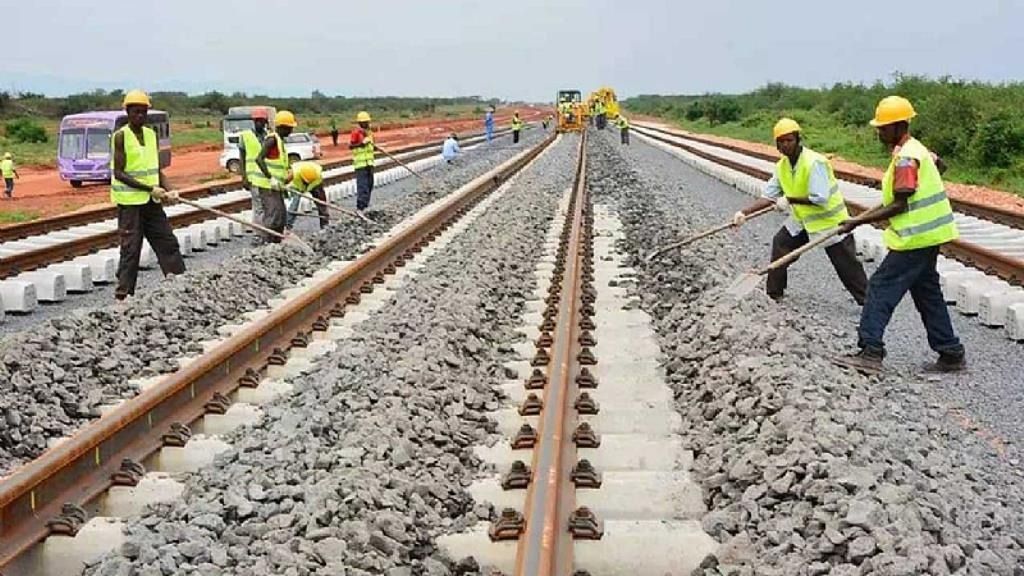
Adebiyi spoke during an inspection tour of the Kano-Katsina section of the rail corridor, saying that the beneficiaries were once unemployed young men from surrounding communities who were recruited, trained on site, and are now handling the entire production work at the yard.
He said the workers, who now own motorcycles,
He said the workers, who now own motorcycles, would be retained as permanent staff of the construction firm after the completion of the project.
“On this site alone, they have recruited over 6,000 Nigerians. That means direct recruitment.
“Everybody you saw there was actually trained on this site, and they are now doing the entire production work on this site. And they will be retained as staff after the completion,” Adebiyi said.
Out of about 6,500 staff working on the project, he said, only about 200 are expatriates, while the rest are Nigerians, most of them drawn from the host communities.
He added that the Federal University of Transportation,
He added that the Federal University of Transportation, Daura, is also recruiting and training Nigerians to sustain the manpower needs of the railway and other transport sectors.
Adebiyi said work on the project had progressed significantly, noting that the framework for all construction activities had been completed, with workers now assembling and coupling the track towards Maradi.
He disclosed that about 800,000 sleepers are to be manufactured from the Kazaure yard, out of which about 650,000 have already been produced, while all other materials required for completion, including reinforcements and rails, are already on site.
Unlike the 189-kilometre Abuja-Kaduna line and the 203-kilometre
Unlike the 189-kilometre Abuja-Kaduna line and the 203-kilometre Kaduna-Kano line, Adebiyi said the Kano-Maradi project is 400 kilometres, with a far more extensive construction yard at Kazaure.
He explained that the workers live within the yard because construction, precasting and other works are done there before being moved to sites for placement, a process which increases cost and construction time.
Adebiyi said the yard is heavily secured, noting that in the last one and a half years, there has been no single instance of banditry or kidnapping on the site.
On the timeline, he said the Kano-Dawanau
On the timeline, he said the Kano-Dawanau to Katsina section will be commissioned in December, while the entire project will be commissioned in December 2027.
He explained that the Katsina to Jibia and Jibia to Maradi sections require international connections, adding that talks have commenced with relevant agencies on security, immigration and customs to ensure speedy movement of plants, equipment and personnel during construction.
Responding to concerns over possible flooding from water channels created in the course of construction, Adebiyi said flood control had been adequately taken care of at the design stage.
He said side drains had been constructed
He said side drains had been constructed and channelled to a ground drain, which was in turn channelled to a discharge point, assuring surrounding communities that there would be no flooding arising from the construction work.
The inspection team, which included the Permanent Secretary, Federal Ministry of Transportation, and the Director-General of the Debt Management Office (DMO), Patience Oniha, and heads of departments and directorates of the two agencies, later visited the Federal University of Transportation, Daura (FUTD), on its way to Katsina along the railway corridor.
Speaking during the visit, the Vice-Chancellor of the university, Prof. Umar Adam Katsayal, called for increased support for the institution to enable it to provide the manpower needed to drive and operate Nigeria’s railway and other transport systems.
Katsayal described the university as an associated infrastructure
Katsayal described the university as an associated infrastructure of the railway corridor, established to provide the needed human capital to drive and operate rail transportation, as well as the other arms of transportation — water, air and road.
He said the delegation had seen things for themselves, and expressed hope that the visit would further strengthen the support the university has been receiving from the Federal Ministry of Transportation, from companies constructing the railway and from companies providing accessories such as signalling and communication equipment.
Katsayal also expressed hope that the DMO would now see the reason the government needs support to provide the funds required for all the projects.
He therefore called on the Ministry to organise a purposeful visit to the university alone, so that the officials could be taken round all the nooks and crannies of the institution to see its facilities for themselves.