



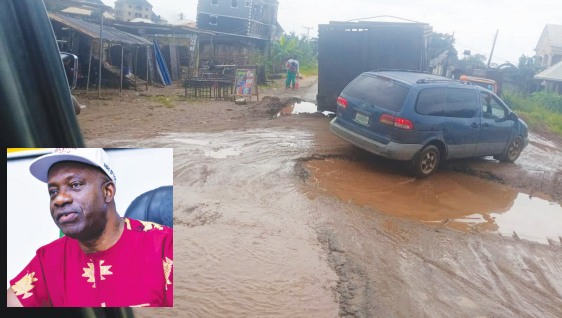
From Adazi to Nnobi, Nnewi to Ozubulu, and Uga Junction to Atani, residents face a troubling question: Are roads Anambra’s being built to last or merely to be commissioned? ECHEZONA OKAFOR reports
The promise of infrastructure development is one that should translate into improved living conditions, economic prosperity, safer transportation and easier movement for citizens.
However, in Anambra State, growing concerns over the condition of several roads executed under the administration of Governor Chukwuma Charles Soludo have raised serious questions about the quality, durability and overall impact of the government’s road construction programme.
Rather than providing lasting relief to motorists, traders,
Rather than providing lasting relief to motorists, traders, farmers, commuters and residents, some road projects have reportedly deteriorated shortly after construction, leaving behind failed sections, dangerous driving conditions and renewed hardship for communities that had hoped for a permanent solution to years of poor road infrastructure.
The situation is particularly troubling because road construction is one of the major development priorities of the Soludo administration.
With the governor’s promise of building a livable and prosperous homeland, citizens naturally expect roads constructed with public re demands of daily traffic and weather conditions
Unfortunately, the condition of some roads across the state appears to contradict that expectation.
Among the roads attracting public concern
Among the roads attracting public concern is the Agwula–Adazi–Nnokwa–Nnobi Road, where portions of the newly constructed road have failed less than six months after construction.
The reported deterioration raises fundamental questions about the quality of materials used, the depth of the road foundation, drainage provisions, supervision and the standard of workmanship adopted by the contractors.
For a road to deteriorate so quickly after construction is a serious development concern. It is particularly disappointing for communities that may have endured years of bad roads before government intervention eventually brought construction to their doorsteps.
The expectation was that the project would open
The expectation was that the project would open up communities, facilitate agricultural transportation, improve commercial activities and reduce the cost and stress of travelling.
Instead, the reported failure of sections of the road has created fresh concerns about public safety and the value received for public expenditure.
Another major corridor attracting attention is the Ekwulobia–Isuofia–Igboukwu–Awka Etiti– Nnobi axis This road network is economically important to communities across the area.
It connects several commercial and residential settlements
It connects several commercial and residential settlements and serves motorists, traders, farmers and other road users who depend on it for their daily activities.
The condition of sections of this corridor has generated concerns among residents and motorists, particularly over the durability of the construction work and whether adequate engineering standards were followed, as most sections of the road are haphazardly done. Making life miserable for motorists.
Similarly, the Nnewi–Ozubulu Road has joined the list of roads whose condition is raising questions about the effectiveness of the state’s road infrastructure programme.
Nnewi is one of the most important commercial
Nnewi is one of the most important commercial and industrial centres in southeastern Nigeria. Ozubulu and neighbouring communities also depend heavily on accessible roads for trade, transportation and other economic activities.
A road connecting such economically significant communities should be built to withstand considerable traffic pressure.
Where sections fail or deteriorate prematurely, the consequences extend beyond inconvenience to motorists. They affect businesses, increase vehicle maintenance costs, delay the movement of goods and undermine economic productivity.
Perhaps even more disturbing is the condition
Perhaps even more disturbing is the condition of the Uga Junction–Atani Road, which has been described by road users as an eyesore.
For residents and motorists who regularly use this route, the state of the road represents another
A road project that should provide relief and improve connectivity should not become an additional burden on the people it is intended to serve.
Where is the quality assurance?
The recurring concerns surrounding these roads raise
The recurring concerns surrounding these roads raise a bigger question about the management and supervision of infrastructure projects in Anambra State.
Road construction is not simply about awarding contracts, mobilising contractors, laying asphalt and organising commissioning ceremonies.
It is an engineering process that requires proper feasibility studies, soil tests, drainage designs, quality materials, competent contractors and independent supervision.
The durability of a road depends on several
The durability of a road depends on several technical factors, including the strength of its subgrade, the quality and thickness of its pavement layers, asphalt composition, drainage infrastructure and the ability of the road to withstand traffic loads.
Where these critical components are compromised, road failure becomes a possibility, sometimes even before the project has served its intended lifespan.
This is why the reported failure of portions of some recently constructed roads within months of completion deserves more than political explanations or routine assurances.
The Anambra State Government should provide detailed explanations
The Anambra State Government should provide detailed explanations regarding the circumstances surrounding these reported failures.
It should also make public the names of the contractors, contract sums, project specifications, completion dates and warranty provisions for the affected roads.
More importantly, an independent engineering assessment should be conducted to establish whether the reported failures resulted from poor construction, inadequate drainage, defective materials, excessive traffic loads, design deficiencies or other factors.
Where contractors are found to have delivered substandard
Where contractors are found to have delivered substandard work, they should be compelled to undertake remedial construction at their own expense, in accordance with their contractual obligations.
Economic consequences for ordinary citizens
The greatest victims of failed roads are not necessarily the politicians or government officials who award and supervise contracts.
They are ordinary citizens. A trader travelling from Nnewi to Ozubulu, a farmer transporting agricultural produce from rural communities, a commercial driver trying to make a living, or a family travelling between neighbouring towns all bear the consequences of poor road infrastructure.
Bad roads increase transportation costs, damage vehicles, delay
Bad roads increase transportation costs, damage vehicles, delay commercial activities and sometimes expose road users to accidents.
For communities that depend on these roads for access to markets, hospitals, schools and other essential services, the consequences can be even more severe.
There is also the danger that roads that deteriorate prematurely will require additional public expenditure for repairs and rehabilitation.
This creates a cycle in which taxpayers effectively
This creates a cycle in which taxpayers effectively pay repeatedly for infrastructure that should have lasted much longer.
The question, therefore, is not whether Anambra needs more roads. The state certainly does. The more important question is whether the roads being constructed are delivering value for the money committed to them.
Governor Chukwuma Soludo’s administration has consistently presented infrastructure development as a major component of its governance agenda.
That commitment should be measured not only
That commitment should be measured not only by the number of kilometres of roads announced or commissioned but also by their quality, durability and usefulness to the people.
A road that looks impressive at commissioning but develops serious defects within a few months cannot be considered a sustainable development achievement.
The governor must therefore demonstrate that his administration is committed to accountability by investigating the reported failures and ensuring that contractors and supervising agencies are held responsible wherever negligence or substandard workmanship is established.
The Ministry of Works and relevant engineering agencies
The Ministry of Works and relevant engineering agencies should also publish periodic reports on the condition of completed roads, particularly those that have attracted public complaints.
There should be no room for political sentiment when public infrastructure is involved. The people’s money must produce infrastructure that serves the people’s interests.
Anambra deserves lasting roads
The people of Anambra State are not asking for anything extraordinary. They are asking for roads that are properly constructed, safely maintained and capable of withstanding the demands of everyday use.
From Agulu, Adazi, Nnokwa and Nnobi to Ekwulobia,
From Agulu, Adazi, Nnokwa and Nnobi to Ekwulobia, Isuofia, Igboukwu and Awka Etiti; from Nnewi to Ozubulu and from Uga Junction to Atani, the concerns surrounding these road corridors deserve urgent attention.
Residents believe that Governor Soludo should not allow questions about road quality to overshadow the broader development objectives of his administration.
The issue is bigger than political opposition or support for any government. It is about public accountability, engineering standards and the welfare of millions of Anambra residents.
Ultimately, the success of a road construction programme
Ultimately, the success of a road construction programme should not be determined by the number of projects awarded, the length of asphalt laid or the photographs taken at commissioning ceremonies.
It should be determined by how long those roads last, how safely people travel on them and how much they contribute to the economic and social wellbeing of the communities they connect.