


Policy establishes national childcare standards, defines care work in Nigerian law for the first time, and classifies care as a formal sector of the economy.
Caring Africa welcomes the approval by the Federal Executive Council, chaired by President Bola Ahmed Tinubu, of the National Care Policy and Implementation Plan, 2026–2030.
The policy was presented by the Federal Ministry of Women Affairs and Social Development and announced by the Honourable Minister, Hajiya Imaan Sulaiman-Ibrahim, at a press briefing in Abuja marking the 26th anniversary of UN Security Council Resolution 1325 on Women, Peace and Security. It was approved alongside the National Action Plan on Ending Violence Against Children and the National Policy on Menstrual Health and Hygiene Management, 2026–2030.
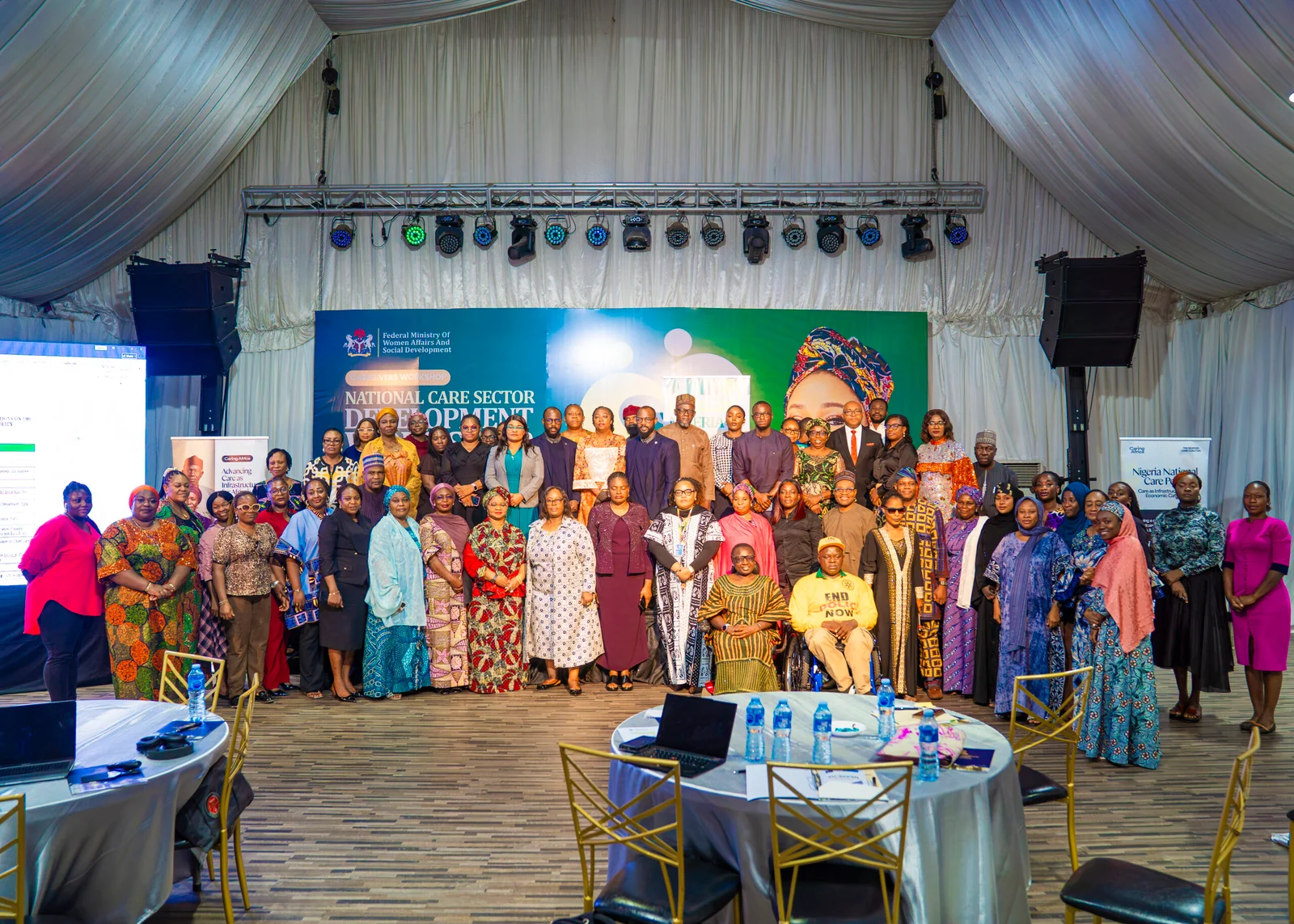
Caring Africa served as technical partner to the Ministry throughout the policy’s development.
Announcing the approval, the Minister said the National Care Policy would recognise unpaid care work and promote safe, regulated childcare and elderly care services.
“It means her work is finally recognised, and that safe, regulated childcare and elderly care will free her time to earn, learn and lead.”
— Hajiya Imaan Sulaiman-Ibrahim, Honourable Minister of Women Affairs and Social Development
The policy spans eleven pillars, accompanied by a costed implementation plan naming lead ministries, performance indicators and delivery dates to 2030.
Care work is defined in Nigerian law. Until now, Nigerian law has contained no definition of a care worker — no occupational classification, no certification pathway, no wage floor and no route to social protection. The policy defines care work as a formal occupation with recognised
categories, establishes certification that recognises experience already earned, provides for a national caregiver register, and commits Nigeria to ratifying ILO Convention 189 on decent work for domestic workers.
Childcare gets a national standard. The policy introduces tiered licensing with enforceable standards on space, staff ratios, safeguarding and nutrition — including a pathway for informal childcare providers to come into compliance rather than be excluded, and provision for a childcare subsidy for low-income households.
Care becomes a formal sector of the economy. For the first time, care is classified as a sector of the Nigerian economy, enabling regulation, the licensing of care enterprises, and access to credit and investment for care businesses — the majority of which are women-owned.
The policy also covers maternal and newborn care extending into the postpartum period, ageing and elder care, disability care and inclusion, employer-supported care, and care financing including a dedicated care line in the federal budget.
Nigerian women spend an estimated 4.3 hours daily on unpaid care work, compared with 1.12 hours for men. Only five per cent of Nigerian children aged nought to two are enrolled in any form of licensed childcare. The National Bureau of Statistics estimates that formalising the care economy could create 17 million jobs. Research by Economist Impact indicates that accessible, quality childcare could bring 1.7 million mothers into Nigeria’s workforce by 2030.
Statement from Blessing Adesiyan, Founder and Chief Care Officer, Caring Africa
“Nigeria has never lacked caregivers. What we have lacked is a system.
For the first time, Nigerian law will recognise care work as work. For the first time, a parent will be able to check whether a childcare facility meets a standard. And for the first time, a woman running a crèche will be able to borrow against a business her government formally acknowledges exists.
We commend the Federal Ministry of Women Affairs and Social Development, and the Honourable Minister, who led this process with real seriousness and moved it at a pace few expected.
Approval is the beginning rather than the end. Health, education and social welfare are delivered at state level in Nigeria. A federal policy that stays in Abuja will not change anything for a woman looking for childcare in Oshodi or caring for her mother in Sokoto. The work now is domestication across the six geopolitical zones and adoption by the 36 states, and that is what will determine whether this policy becomes real.”
Nigeria joins a small group of countries that have adopted national care policies. Brazil enacted its National Care Policy in 2024 and followed it with a funded national plan. Chile signed Chile Cuida into law in 2026. Kenya launched its national care policy, the second in Africa after Cape Verde, and is implementing at county level. UN Women currently supports more than fifty countries developing national care systems. Nigeria is the largest economy on the African continent to adopt such a policy.
Caring Africa is a care economy policy and technology organisation, and served as technical partner to the Federal Ministry of Women Affairs and Social Development on the National Care Policy and Implementation Plan.
Media contact
Taye Oyeleye | Email: hello@caringafrica.org
The policy framework is published at nigeriacarepolicy.org