


Follow THISDAYLIVE on GoogleAdd us as a preferred source to see more of our stories in Google
With 17 aspirants in the race for the Government House, the contest is gradually taking shape as political heavyweights Idris and Malami emerge as frontrunners in what promises to be a fiercely contested battle, writes Onuminya Innocent
In Kebbi State, politics is rarely predictable. It is a state that prides itself on education, enlightenment and a stubborn independence at the ballot box. As the 2027 governorship race gathers momentum, that character is once again on full display.
About 17 governorship candidates are jostling for the Government House, Birnin Kebbi. But on the streets, in markets, in motor parks and at political meetings across the 21 local government areas, the conversation has narrowed to two names.
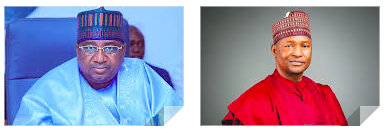
On one side is the incumbent, Governor Dr. Nasiru Idris of the All Progressives Congress (APC), seeking a second term. On the other is Abubakar Malami, SAN, former Attorney-General of the Federation and Minister of Justice, now flying the flag of the African Democratic Congress (ADC).
It is a contest that is already shaping up as more than a governorship election. It is a test of incumbency against structure, of loyalty against ambition, and of a political godfather turned rival.
A State That Votes With Its Head
Kebbi, in the North-West, was carved out of the old Sokoto State, which today comprises Sokoto, Kebbi and Zamfara States. It is widely regarded as home to some of the most educated people in that old Sokoto axis.
That reputation matters in politics. Analysts who have followed Kebbi elections since 1999 say the electorate hardly votes on sentiment alone. They vote, in the words of one observer, for competence, capacity and performance.
That is why, despite the noise and the crowd of aspirants, many in the state believe the final battle will be decided not by party slogans but by who the people trust to deliver.
Idris: The Quiet Incumbent Banking on Performance and Relationships
Governor Idris came to power in 2023 on a wave of goodwill. His supporters say he has not wasted that goodwill.
To them, he has done well and deserves a second term. They point to his humility, a trait that has endeared him to many, and his deliberate effort to maintain peace with those who ruled the state before him.
Unlike in many states where former governors become sworn enemies of their successors, Kebbi is different under Idris, his allies insist. All those who have governed the state since 1999 are said to be with him. That unity, they argue, is a rare political asset.
He has also cultivated the traditional institution. Traditional rulers in the state, long seen as custodians of grassroots influence, say the governor holds them in high esteem and has improved their welfare. In a state where the emir’s word still carries weight in remote communities, that relationship is not cosmetic.
Then there is the Aliero factor. Senator Adamu Aliero, representing Kebbi Central Senatorial District, is arguably one of the strongest politicians in the state. A former governor and former Minister of the Federal Capital Territory, Aliero has a political machine that has survived several election cycles.
The governor is banking heavily on him to deliver the Central zone, the most populous and politically decisive of the three senatorial districts. If Aliero delivers Central, Idris’s path to re-election becomes much smoother.
Beyond personalities, Idris enjoys the classic advantages of incumbency. He has structures across all 21 local governments. Commissioners, special advisers, special assistants and local government chairmen are all, in theory, his foot soldiers.
He also controls state resources. In Nigerian politics, financial strength is not a minor detail. It determines how far a campaign can travel, how many rallies it can hold and how effectively it can mobilise on election day. But incumbency is a double-edged sword.
Weaknesses/Disadvantages
Critics of the governor are unsparing. They argue that, with the huge monthly allocations coming from the Federation Account, Kebbi should look different by now. Roads, water, schools and hospitals, they say, have not improved at the pace the money suggests. To them, the administration has not done enough in terms of infrastructure.
There is also the allegation, repeated often by opponents, that the governor has enriched a few people close to him, while the majority still wait for the dividends of democracy.
Whether those claims will stick with voters is another matter. But they have given the opposition a ready-made campaign message: that Kebbi deserves more for what it earns.
Then there is the Tinubu factor. Across parts of Kebbi, a slogan against President Bola Ahmed Tinubu has been gaining traction. In a state where presidential popularity often trickles down to governorship contests, analysts warn that anti-Tinubu sentiment could become a liability for Idris, who is running on the APC platform.
If the presidential election mood turns sour in Kebbi, the governor may find himself fighting two battles at once: defending his own record and defending his party’s national image.
Malami: The Insider Turned Challenger
If Idris is the incumbent, Malami is the insider who knows where the bodies are buried. A household name in Kebbi politics, Malami was instrumental to Idris’s victory in 2023. He was not a bystander. He was a key architect of the coalition that brought the governor to power.
That history is now the central drama of the 2027 race. The man who helped make the governor is now determined to unseat him. Malami’s political structure is not new. Known across the state as Malami SAK, it has a presence in all local governments. It is a grassroots network built over the years through appointments, empowerment programmes and personal loyalty.
His greatest strength, supporters say, is his base. Especially among the youth, Malami commands a following that is passionate and organised. They are not just supporters, one aide said; they are ready and willing to defend their votes. That energy could be decisive in a state where youth turnout is often high.
Financially, Malami is also no pushover. Despite his ongoing case with the Economic and Financial Crimes Commission (EFCC), he is said to have enough financial muscle to match the incumbent, naira for naira, rally for rally. In Nigerian politics, where money often determines reach, that matters.
The Bande and Maidoki Factors
Malami is not going into the battle alone. He has assembled a team of political heavyweights who bring their own structures.
Chief among them is Major General Aminu Bande (rtd), former General Officer Commanding 8 Division, Sokoto. Bande is a grassroots mobiliser with deep roots in Kebbi Central. He is also the ADC senatorial candidate for Kebbi Central. His presence in the ADC camp is strategic. It gives Malami a direct counterweight to Senator Aliero in the Central zone. If Bande can split Central, the governor’s strongest pillar weakens.
In the South, Malami has Senator Garba Musa Maidoki. Maidoki, representing Kebbi South, is a strong politician in his own right. He famously defected from the APC close to the 2023 election and defeated his opponent, a feat that still resonates in Kebbi politics.
He is now the ADC candidate for Kebbi South. His defection gives the ADC a sitting senator, a tested campaigner and a man who knows how to win against the APC machine.
Together, Bande and Maidoki give Malami what every challenger needs: credible lieutenants in two of the three zones.
The Atiku Wind
Beyond Kebbi, national politics is also blowing in Malami’s favour, at least according to his camp. Many people in Kebbi, analysts note, are rooting for former Vice President Alhaji Atiku Abubakar. Atiku has a long-standing following in the North-West, and Kebbi is no exception.
If that pro-Atiku sentiment translates into anti-APC voting, the odds may favour Malami and the ADC. The governorship race, in that sense, may be fought partly on national currents beyond the control of either candidate.
Malami’s Own Burden
But Malami carries his own baggage into the race. His corruption case with the EFCC remains the sharpest weapon in the hands of his opponents. They use it at every campaign stop to question his integrity and fitness for office. For undecided voters, it is a question that will not go away easily. There is also the problem of incumbency, or rather, the lack of it.
Pundits argue that, without the power of incumbency and without control of government at the centre, Malami will have to work extra hard to defeat a sitting governor. He has no commissioners to deploy, no state apparatus to lean on and no official platform to showcase performance. He must win on structure, popularity and message alone. That is a tall order in Nigerian politics, but not an impossible one. Kebbi has produced upsets before.
What Will Decide It?
As the campaigns unfold, three questions will likely decide Kebbi 2027. First, will voters reward Idris for stability, humility and continuity, or punish him for perceived underperformance despite huge allocations? Second, can Malami convert his personal popularity, youth base and alliance with Bande and Maidoki into votes across all three zones, despite the EFCC case hanging over him?
Third, how much will national politics, from the Tinubu factor to the Atiku factor, shape a state election that is, at its core, about Kebbi?
For now, both camps are confident. Idris’s camp speaks of performance and structure. Malami’s camp speaks of change and a new beginning.
With 17 candidates in the race, the field may thin out as alliances form and negotiations intensify. But all eyes are already on the two gladiators.
In Kebbi, where the people pride themselves on voting with their heads, the 2027 governorship election may yet prove to be one of the most keenly contested in the North-West.