

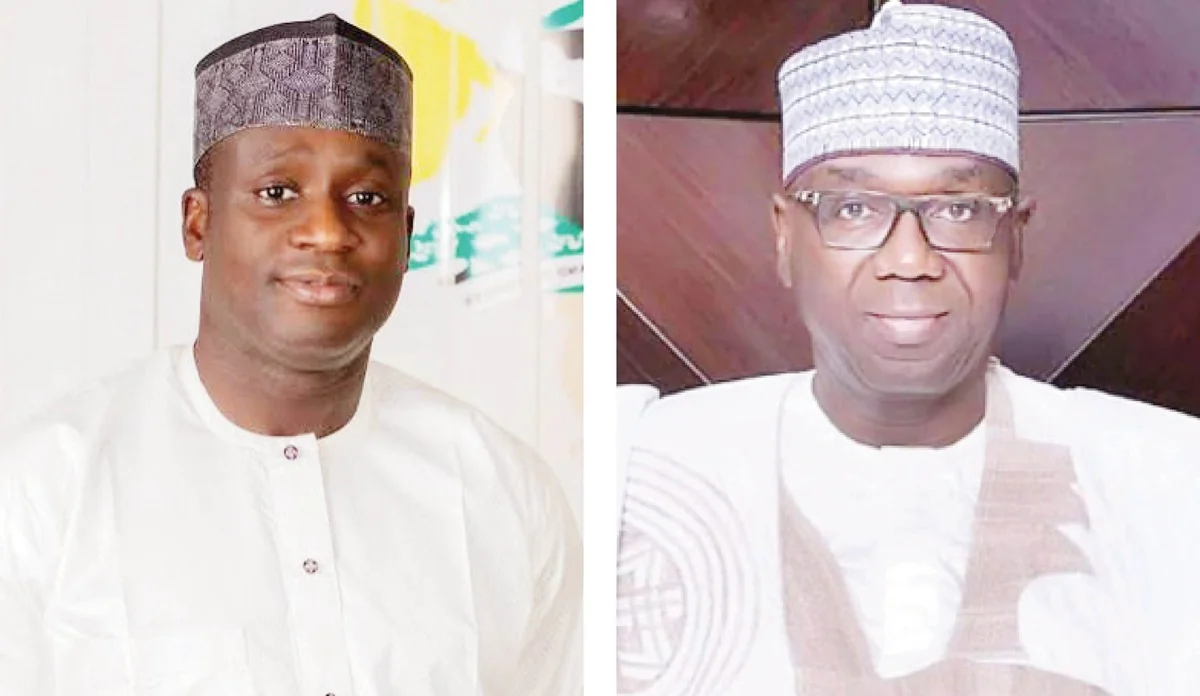
It is not strange to have second term state the governors in Nigeria desiring to install successors after expiration of their tenure. Political analysts have gone ahead to deduce reasons for the practice.
Political watchers, in their opinions, hold the view that the need to ensure continuity of policies and programmes is one of the reasons behind installing successors, while some other people said that the reason may not be outside the fact that second term governors would prefer a successor that could be trusted to protect their legacies from scrutiny after leaving office.
In Kwara State, installing a successor is the ultimate test of power and history shows even the strongest second-term governor can only go as far as party unity and public mood allow him.
The pattern in the Fourth Republic:
Mohammed Lawal (1999-2003). He was installed by late Olusola Saraki (Oloye), fell out with him, and Saraki withdrew support and installed someone else.
Bukola Saraki (2003-2011). After inheriting his father’s structure, he anointed Abdulfatah Ahmed in 2011 against his father’s preference and won. He then secured Ahmed’s second term in 2015. According to some of his loyalists, that success made him the most successful kingmaker in Kwara since 1999.
Abdulfatah Ahmed (2011-2019). As a second-term governor, he could not install his own successor because the Bukola Saraki structure that backed him collapsed in the 2019 Otoge revolution. AbdulRahman AbdulRazaq won on anti-godfatherism basis.
AbdulRahman AbdulRazaq (2019 – present). This is the present political situation in Kwara state. As Governor AbdulRahman AbdulRazaq rounds off his second term by 2027, Nigerian Tribune findings show intense moves to anoint a successor from Kwara North for equity, since Kwara North senatorial district has never produced an elected governor since 1999.
For instance, political stakeholders and enthusiasts in Kwara State saw it coming when moves and body language of the incumbent and second term governor, Mallam AbdulRahman AbdulRazaq, indicated his preferred successor(s) among the aspirants that showed interest in the 2027 governorship race in the ruling All Progressives Congress (APC).
In the May 2026 APC party primaries in Kwara State, 15 governorship aspirants started the race while 10 of them formally protested, however, six votes counted in the final.
At the rescheduled primary on May 22, 2026 that produced Speaker Yakubu Danladi-Salihu as candidate, the official result sheet showed six aspirants polling votes:
Yakubu Danladi – 94,990 votes
Abdulfatai Seriki – 41,700 votes
Bashir Bolarinwa – 22,118 votes
Femi Sanni – 5,990 votes
Ibrahim Oloriegbe – 3,910 votes
Dele Belgore – 3,411 votes.
Governor AbdulRahman AbdulRazaq has been explicit in his argument for supporting the turn of Kwara North anchoring it on equity and fairness.
According to a political affairs commentator in the state, Yekini Abdulazeez, while describing the fortune of Kwara North as a history of exclusion, said that perceived exclusion of the Kwara North district requires political courage to correct it.
“Kwara State, created in 1967, is divided into three senatorial zones: North, Central, and South. Since the start of the Fourth Republic in 1999, the governorship has rotated between Kwara Central and Kwara South. The late Admiral Mohammed Alabi Lawal (1999–2003) hailed politically from Kwara Central, as did his successors, Dr. Bukola Saraki (2003–2011). Mallam AbdulRahman AbdulRazaq, the current governor, also hails from the Central region of Kwara state.
Kwara South, through Senator Cornelius Adebayo (military handover era) and Governor Ahmed, has had a share. Kwara North, comprising five local government areas, Baruten, Edu, Patigi, Kaiama, and Moro, has had no elected governor. Its closest claim was Admiral Lawal, whose maternal roots were from Baruten but who identified politically with Ilorin.
Abdulazeez went on to say that Kwara’s silence on zoning has resulted in near-permanent rotation between Central and South, to the exclusion of the North, adding that the silence now requires political courage to correct.
Also speaking on the issue, the candidate of African Democratic Congress (ADC) for the Ilorin East/Ilorin South federal constituency in the 2027 general elections, Dr. Sa’ad Oladimeji Issa, agreed that Kwara North district has for so long been neglected when compared to number of years which other districts have produced governors of the state.
Dr. Issa, also known as Ikokoro, however, has reservation for someone having a particular candidate from the area as an interest.
He said: “Really and truly, I must say, I’m also a very strong advocate for equity and fairness. So, if we look back to the start of this political dispensation, you can see that clearly Kwara North has been significantly neglected. So I agree completely that the narrative of a Kwara northerner coming for this position is imperative. However, the concern that I have is all about having a particular candidate as an interest.”
The politician said that there are a lot of Kwara northerners that are essentially qualified to go for the APC primaries, and quickly added that, “Kwara is not peculiar. Most incumbent governors, would want to have a succession plan, you know, someone to take over from them.
“If you ask me, I really don’t know why. But frankly, I think if we say government is a continuum, regardless of who is coming, so long we have reached a decision on having Kwara Northerners. And then, of course, the primary election that you conduct, you should make sure that it’s centered around potential candidates from that region. And then you give a fair competition.
“But a lot of assumption and a lot of concern by even the ruling party were expressed. I’m not in the APC, but from what we heard, there were a lot of pandemonium with regards to who should come forth to be the gubernatorial candidates under the APC.
“But, you know, the thing is, if by par adventure, this was done in a way that gives all the candidates the feeling that there is equity, even in the process of selection, I think even less noise would have been heard about it.
“I mean, godfatherism is there. And I believe it will always be there in Nigeria. But the narrative of that cannot give me concern because, you know, godfatherism is one thing and trying to hide behind godfatherism for a perpetuation of a particular plan is another,” he said.
Dr. Issa, who said that godfatherism would be difficult to wish away in the nation’s political system, “because even the electorate don’t really understand. I mean, look at what is happening in recent times. In the last dispensation, when we said Otoge, Otoge was an uprising, a revolution against godfatherism. But what is happening right now is nothing really far from what we wanted to desist from the first time. “So, I mean, are we going to have a political system in this country that is going to be free and fair, devoid of political godfatherism? I really, really hope we get there someday.
But I don’t think it’s something that can really happen. The beauty we have in ADC is that we have moved a bit further from there. And I think what we have done in ADC is to create a level playing field that does not have Godfatherism notion within it. And I think that is very fundamental. If we have Godfatherism, someone like me might not have even emerged as a candidate under ADC. It was a level playing field and we feel that competence.
“And when you have godfatherism most of the time, it’s not really about people who are competent. It’s about people who can be favoured or people who would be able to dance to the tune of the Godfather. But when you have a level playing field like we have in ADC, I don’t have anybody that I would say is sponsoring anything for me. We have a fair competition.
“On the contrary, look at what happened in the G15, the G10. And there were a lot of people who were discontented about the last primaries. It didn’t happen in ADC. Clearly, I think it was a good thing for us,” he said.
ALSO READ: 2027 polls: INEC to test BVAS in 17,676 polling units, Saturday
But how far can a second term governor go to install a successors? A political analyst, Olaiya Hafiz, answered, saying that, “Legally, they can endorse, fund, and push through the party structure.
Practically, Kwara State has shown that if anyone tries to impose a governorship candidate, same situation of resentment that allegedly removed Saraki in 2019 may be created.
Thus, analysts now frame 2027 as a battle between “rotation to Kwara North” and “anti-godfatherism”.
According to pundits, a second-term governor can anoint, but cannot guarantee victory. They said that success depends on three things; Zoning argument being accepted (Kwara North agenda is strong this time); Whether party elders buy into the consensus; Whether voters see it as continuity or imposition — Kwarans have twice rejected imposition, in 2003 and 2019.
WATCH TOP VIDEOS FROM NIGERIAN TRIBUNE TV