




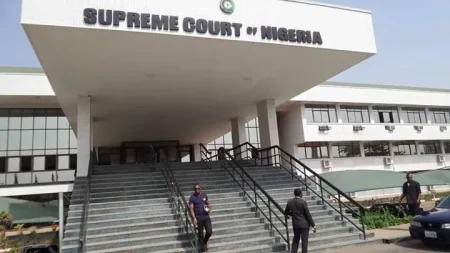
Nigerian politicians should approach courts, stop attacking Judges
Nigerian politicians who aspire to hold public office are expected to set a good example for citizens to follow. Nigerian courts are established by the 1999 Constitution of the Federal Republic of Nigeria (as amended) to provide aggrieved citizens with a lawful path to Justice instead of self-help.
Therefore, both politicians and citizens owe respect to the Nigerian Judges presiding over their cases in courts. It is unfair and unacceptable to see aggrieved politicians who lost a case in court begin to attack the presiding Judge instead of going to an appellate court to appeal the Judgment.
Every reasonable Nigerian knows that a court will always decide a case based on the overwhelming evidence placed before it, as no court in Nigeria delivers Judgement outside the case presented before it by both parties.
When there is no allegation of bias, I
When there is no allegation of bias, I wonder what offence the Judge has committed to warrant such attacks from the Nigerian politicians and their citizens.
Alhaji Tunde Taofeek Olagunju: Tribute to an exceptional leader, mentor, father figure
As you bow out of active service after 35 remarkable years of dedicated service, I find it difficult to let this moment pass without expressing my heartfelt appreciation for the privilege of working under your leadership.
Sir, you are more than a boss. You are magnanimous, compassionate, exceptional, distinguished, inspirational, benevolent, exemplary, philanthropist, selfless to the core, an angel in human form, prayer warrior, a rare breed of administrator and accountant per excellence who genuinely desires the growth, progress and success of those working with him.
Your willingness to support your subordinates, encourage
Your willingness to support your subordinates, encourage their aspirations and bring out the best in them speaks volumes about the kind of person you are.
Over my 20 years in Local Government Service I have not come across a contended and friendly Oga at the top who relates freely with his workers and makes the work environment so conducive and lively.
Although I have had the privilege to work with Alhaji Tunde Taofeek Olagunju for just five months, the impact he has made on me is truly immeasurable.
Sir, in this short period, I have experienced
Sir, in this short period, I have experienced your kindness, encouragement, generosity of spirit and uncommon concern for the wellbeing and advancement of everyone around you.
You have shown me that leadership is not merely about occupying an office or exercising authority, but about touching lives, creating opportunities and leaving people better than when you met them. I am particularly grateful for the support, confidence and consideration you have extended to me.
What some may take years to demonstrate, you have shown in just a few months. I will never take your kindness for granted sir. As you transition from active service into a new phase of life, I celebrate not just your 35 years of service but the many lives you have touched, the people you have inspired and the positive legacy you leave behind.
Thank you, Sir, for being an exceptional leader,
Thank you, Sir, for being an exceptional leader, boss, father figure and for making my journey under your leadership a memorable one. May God reward your years of selfless service with sound health, renewed strength, peace, happiness and many more fulfilling years. Congratulations, Sir.
You have truly earned this honour and celebration. Happy retirement to my dear boss, a magnanimous Oyekunbi Adediran , Information Officer, writes from IBSWLG, Ibadan, Oyo State
Will state policing bring security closer to the people?
The news that the constitutional amendment bill for the creation of State Policing has crossed the approval of state assemblies is a historic turning point for Nigeria.
For many years, citizens have cried
For many years, citizens have cried for a change in security. Our current system, where a Governor must practically beg a central command in Abuja before deploying men to stop a local attack, has failed.
Yet, as we stand at this point, one question remains: Are we bringing security closer to the grassroots, or are we simply handing state governors a new weapon of oppression?
Many people support state policing, by establishing state forces, officers will be recruited from the very communities they swear to protect. They will know every bush, every shortcut, and every face. Other people are afraid.
They say in a country where local government
They say in a country where local government elections are routinely hijacked by the ruling party in the state, what stops a governor from turning a state police force into a personal weapon?
There is a real risk that these forces will be used to suppress journalists, intimidate political opponents, and muzzle free speech during election seasons. State policing will benefit us because governors, as the chief security officers of their states, will finally have the power to respond to emergencies without waiting for a distant order from Abuja. Help will come faster.
Communities will feel safer. Young people in each state will also get jobs. It will also reduce the burden on the federal police, so the federal police can focus on bigger crimes like terrorism, border security, and crimes that cross from one state to another.
According to a report by the Nigerian Tribune,
According to a report by the Nigerian Tribune, the Lagos State House of Assembly in October, approved the state police bill, faulted federal control of police, and sought a parliamentary police like the United States.
The report also stated that Kogi, Sokoto and Ebonyi Assemblies passed the bill. The Lagos Speaker, Rt. Hon. Mudashiru Obasa, was quoted as saying the current arrangement where the federal government has total control of police was not working,
and that state policing would enhance intelligence gathering and allow states to respond faster to insecurity, banditry, kidnapping and other criminal activities.
For this system to work, the National Assembly
For this system to work, the National Assembly must build strong constitutional safeguards, with civil society, legal experts, and community leaders to serve as a check on executive overreach.
Decentralization is the right path forward, but only if it is accompanied by rigid safeguards. If we rush into this blindly out of fear, we might find out too late that the monster we created to protect us has turned around to devour us.
Oladele Grace, a student writes from the Department of Education, Science and Technology, Bamidele Olumilua University ,Ikere-Ekiti, Ekiti State
2027: Between violence, viral lies
The competing videos surrounding President Tinubu’s convoy incident
The competing videos surrounding President Tinubu’s convoy incident in Abuja reveal a defining vulnerability ahead of Nigeria’s 2027 elections. Physical disruption on the ground is now inseparable from instant distortion online.
When a single street flashpoint produces rival footage within minutes, public debate shifts from accountability to partisan speculation. TrackExec Orders Left unchecked, the convergence of campaign intimidation and unverified digital claims threatens far more than individual candidates or parties.
It erodes citizens’ willingness to participate, weakens trust in electoral and security institutions, and tests whether Nigeria’s democratic architecture can contain friction before it hardens into crisis. The Electoral Act prohibits political violence, intimidation, and disorderly conduct at campaign meetings under Sections 96, 97, and 120.
Section 148 empowers INEC’s legal officers or appointed
Section 148 empowers INEC’s legal officers or appointed counsel to prosecute electoral offences in state High Courts, Magistrate Courts, or the FCT. The persistent gap lies between statutory design and institutional practice.
Civil society groups, including SERAP, have repeatedly noted that arrests at campaign flashpoints too often stall before reaching the courtroom. Several structural factors drive this pattern.
Prosecutorial and judicial capacity remains thin; many state Ministries of Justice and police legal units lack dedicated electoral offence desks with the specialised knowledge and case-management systems required for timely action.
Political cost calculations, charging actors linked to influential
Political cost calculations, charging actors linked to influential candidates or parties risks internal pressure, delayed promotions, or transfer frequently override formal rules. FollowPolitics
The broader culture of delayed justice means even well-documented cases can languish for months or years, by which time deterrent value has evaporated. Coordination between the Police, INEC, and the Ministry of Justice remains episodic rather than institutionalised, allowing each actor to claim the file is elsewhere.
As the National Peace Committee has observed, a signed peace accord carries weight only when institutions demonstrate the resolve to hold violators accountable regardless of affiliation.
Without visible, timely prosecution across political divides, moral
Without visible, timely prosecution across political divides, moral suasion loses force and the incentive structure continues to favour disruption over restraint.
Protecting the integrity of the January and February 2027 polls requires shifting from reactive crisis management to preventive institutional coordination. Four practical steps can strengthen Nigeria’s electoral peace architecture over the next eight weeks.
INEC, the Nigeria Police Force, and the Ministry of Justice should activate dedicated prosecutorial desks under Section 148 of the Electoral Act, staffed with officers measured by case progression rather than arrest numbers alone.
Fast-tracking a limited but visible set of documented
Fast-tracking a limited but visible set of documented cases spanning all political divides would signal that campaign disruption carries real legal consequences.
Public reporting of case status would further reduce selective enforcement claims and rebuild credibility. When contested videos or false electoral notices go viral, delayed official communication creates a vacuum.
INEC and security agencies should institutionalise a two-hour verification and public-briefing protocol, using clear, non-partisan visual advisories across radio, television, and social platforms.
Speed and consistency matter more than perfection
Speed and consistency matter more than perfection. CheckVoting Info High-level peace accords signed in Abuja must be mirrored by active state and local-government peace committees in high-risk jurisdictions identified by monitoring data Kaduna, Edo, Enugu, Plateau, and Taraba among them.
Engaging traditional rulers, religious leaders, youth representatives, and transport unions helps de-escalate rally routing conflicts and community tensions before they spiral.
Local legitimacy often exceeds the reach of national pronouncements. Elections in a competitive democracy will always generate passionate debate, robust mobilisation, and sharp policy disagreement.
Dissent and vigorous campaigning are signs of democratic
Dissent and vigorous campaigning are signs of democratic vitality, not instability. What threatens the social fabric is the normalisation of coercion at rallies and deliberate distortion in the public square.
The data already show rising election-specific incidents, concentrated breaches of the Peace Accord, and an information environment that amplifies friction faster than institutions currently clarify it.
Anchoring responses in transparent law enforcement, platform-aware early warning, rapid factual communication, and inclusive local mediation remains the most reliable path to steadying the pre-election environment.
Safeguarding the peace ahead of 2027
Safeguarding the peace ahead of 2027 is a shared national investment. It is also a test of whether Nigeria’s institutions can close the gap between legal design and operational practice before the window closes.
The quality of that response will determine not only the integrity of the January and February polls, but the durability of citizen confidence in the democratic process itself. Lekan Olayiwola writes
YOU HAVE A RIGHT TO BE HEARD! SEND YOUR LETTERS AND PHOTOGRAPHS TO [email protected]. LETTERS SHOULD NOT BE MORE THAN 200 WORDS AND MUST HAVE THE NAME AND ADDRESS OF THE SENDER.


1 Comment
Pingback: Expedite Action On SSB Tax Reform Bill - News Press NG Copy