




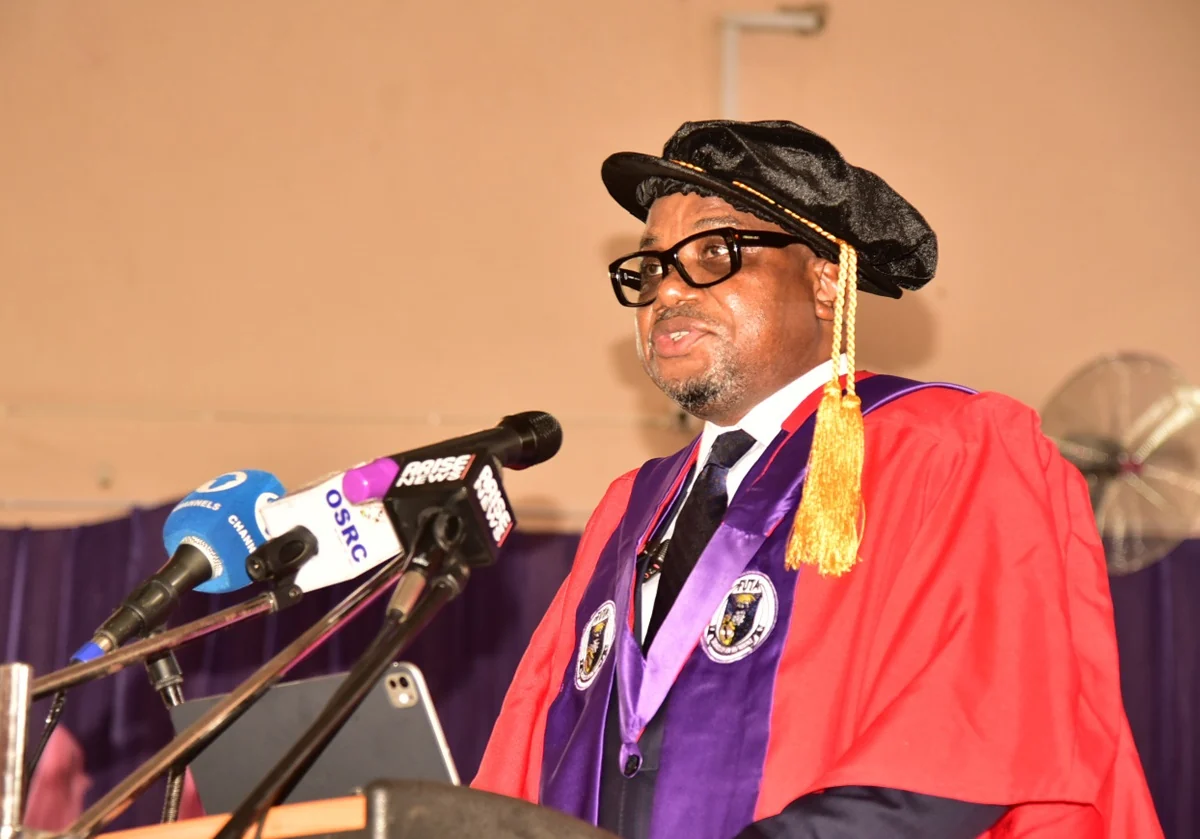
The Group Managing Director and Chief Executive Officer of Access Holdings Plc, Mr Innocent Ike, has challenged Nigerian graduates to take an active role in national development by using their knowledge, skills and creativity to address the country’s socio-economic challenges rather than waiting for the economy to improve.
Ike urged the graduates to embrace entrepreneurship, innovation and leadership, describing Nigeria’s development challenges as opportunities for wealth creation and national transformation.
He stressed that their education should equip them to provide solutions to the country’s problems and contribute meaningfully to economic growth.
Ike, who delivered the 37th Convocation Lecture of the Federal University of Technology, Akure (FUTA), on Friday, described Nigeria’s numerous development challenges as opportunities for innovation, entrepreneurship and wealth creation.
Speaking on the theme “From Akure to the World: The Next Chapter Is Yours to Write”, the banking executive challenged the graduands to see themselves as agents of national transformation through leadership, enterprise and active participation in the political process.
“Your degree is not a certificate to frame while you wait for the economy to improve. It is a tool to help improve it,” he declared.
He warned that Nigeria’s youthful population, with a median age of about 18 years, could become a national liability if the country failed to provide adequate education, employment and opportunities for young people to contribute to economic growth.
Citing the United Nations’ World Population Prospects 2024, Ike said the country’s demographic profile offered a significant advantage but stressed that deliberate investment in human capital was necessary to translate the opportunity into economic prosperity.
He identified inadequate electricity, poor road infrastructure, insecurity, limited healthcare access and funding constraints as some of Nigeria’s major development challenges, noting that they also presented opportunities for young entrepreneurs.
According to him, sectors such as solar energy, post-harvest storage, logistics, financial inclusion, digital healthcare and educational services offered considerable prospects for innovation and business development.
“Every national challenge is also a market,” he said, urging aspiring entrepreneurs to maintain transparent financial records, separate personal and business finances, build credible reputations and ensure that business expansion was supported by sustainable systems and cash flow.
READ ALSO: Nigerian researcher honoured for AI, cybersecurity contributions in China
On the changing global economic landscape, Ike said artificial intelligence was reshaping the world of work, with technology increasingly capable of performing tasks such as writing, designing, data analysis and computer programming.
He, however, cautioned that access to technology alone would not guarantee success, stressing the importance of identifying problems, developing relevant solutions and applying knowledge productively.
Addressing leadership and governance, the Access Holdings chief executive described leadership as a personal responsibility rather than a position of authority, urging the graduates to participate actively in the democratic process.
“Leadership is not a position; it is a choice to take responsibility,” he said.
He encouraged them to vote, follow public issues beyond political personalities and hold elected officials accountable with facts, adding that “nation building is not a spectator sport.”
On the increasing migration of Nigerian graduates abroad, Ike said relocating should not amount to abandoning the country, urging those who sought opportunities overseas to maintain meaningful connections with Nigeria and contribute to its development.
He also called on government to prioritise reliable electricity, affordable internet access, security and predictable policies, while urging financial institutions to provide young entrepreneurs with patient capital and mentorship.
In her address, the Vice-Chancellor of FUTA, Prof. Adenike Temidayo Oladiji, highlighted the institution’s academic, research and infrastructural achievements, including the completion of a 4.5-megawatt solar hybrid power project aimed at improving electricity supply on the campus.
Oladiji disclosed that the project, funded by the African Development Bank under Phase III of the Federal Government’s Energising Education Programme, included 5.5 megawatt-hours of battery storage.
She described the development as a major milestone in the university’s commitment to sustainable energy and improved academic productivity.
The Vice-Chancellor also announced the successful accreditation of FUTA’s College of Health Sciences, describing it as a significant step towards the training of medical professionals.
She acknowledged the contributions of the Federal and Ondo State governments, the Deji of Akure and the Akure community to the conversion of the former Ondo State Specialist Hospital into a federal asset for the university’s teaching hospital.
On agricultural research and development, Oladiji said the university had expanded its oil-palm plantation from 18 to 61 acres, established greenhouses for tomato and bell pepper production, and planted improved oil-palm and coconut seedlings, alongside new cocoa and cassava plantations.
She added that the university’s poultry farm now had 5,000 layer birds, while its feed mill served both commercial purposes and practical entrepreneurial training.
The Vice-Chancellor further disclosed that 11 academic staff members and three alumni of the institution were recognised in Stanford University’s 2026 ranking of the world’s top two per cent of scientists.
She also announced that FUTA’s Department of Meteorology and Climate Science had been reconfirmed by the World Meteorological Organisation as a Regional Training Centre for another five years.
WATCH TOP VIDEOS FROM NIGERIAN TRIBUNE TV