

A Professor of African History, Peace and Conflict Studies at the Institute for Peace and Strategic Studies, University of Ibadan (UI), Isaac Olawale Albert, has asserted that 2027 will be the most challenging election period in Nigeria’s history.
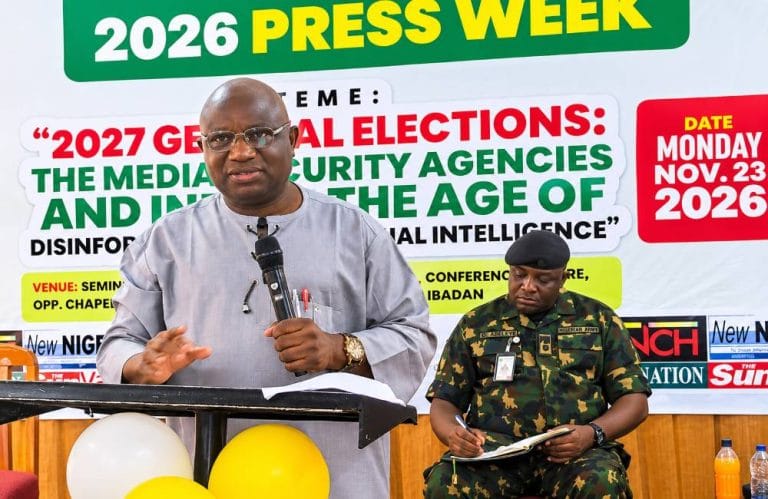
Albert said this during the 2026 Press Week of the Correspondents’ Chapel of the Nigeria Union of Journalists (NUJ), Oyo State Council, in Ibadan, led by Yinka Adeniran of The Nation Newspaper.
Speaking on the lecture with the theme: “2027 General Election: The Media, Security Agencies and INEC in the Age of Disinformation and Artificial Intelligence”, Albert noted that as the 2027 general elections approach, there will be concerted attempts to manipulate information, spread misinformation, and exaggerate minor issues to the extent that citizens might begin to doubt the credibility of the election results.
According to him, the world is now
According to him, the world is now in a digital era where various strategies for malign information operations can be easily deployed.
“We had, in the past, problems of ballot box snatching, voter intimidation, electoral violence, vote buying, and result falsification. Today, while these threats remain, a new battlefield has emerged. This battlefield is digital.
“We now have Artificial Intelligence that enables individuals and organisations to generate highly realistic text, images, audio, and video content within minutes. AI-generated fake election results could be circulated before the Independent National Electoral Commission (INEC) makes official announcements, alongside deepfake videos designed to inflame ethnic tensions, among other threats”, he said.
He warned that journalists, security agencies, INEC,
He warned that journalists, security agencies, INEC, and other stakeholders must be prepared to address the challenges posed by AI to ensure transparency, accountability, inclusiveness, fairness, credibility, and public trust in the 2027 general elections.
Albert, who noted that AI carries both advantages and disadvantages, advocated for its responsible use, stressing that technology must complement professional judgment rather than replace it.
“Accuracy, verification, fairness, and editorial responsibility must remain central to journalism. AI should be treated as both an opportunity and a security challenge,” he said, adding that journalists, INEC, and security agencies must develop the skills, institutional capacity, and safeguards required to use AI responsibly while protecting electoral credibility and public trust.
On his part, the General Officer Commanding (GOC),
On his part, the General Officer Commanding (GOC), 2 Division, Nigerian Army, Maj.-Gen. Auwalu Mahmuda, assured that the Army would remain apolitical and neutral, act professionally, and stay away from politics except where intervention becomes strictly necessary.
Mahmuda, who was represented by the Acting Deputy Director, Army Public Relations, 2 Division, Lt.-Col. Danjuma Jonah, said the security success recorded during the off-cycle governorship election in Osun State would be replicated in the 2027 general elections.
He added that the Army would collaborate with the media, police, and other security agencies to ensure credible and fair elections acceptable to the international community.
In his remarks, the Commissioner of Police
In his remarks, the Commissioner of Police in Oyo State, Abimbola Olugbenga, represented by CSP Adeshina Olatunji, said the police had mapped out strategic measures to guarantee credible elections in 2027.
Similarly, the Commandant of the Nigeria Security and Civil Defence Corps (NSCDC), Oyo State Command, Augustine Padonu, represented by DCC Oluwole Olusegun, said the corps would collaborate with all security agencies in the state to ensure hitch-free polls.
The Chairman of the occasion, Prof. Soji Adejumo, who appreciated the security agencies, INEC and other stakeholders for their contributions to the progress so far recorded in Nigeria’s democracy, described the Nigerian election as one of the most difficult elections to handle.